University of Wisconsin-Madison drives efficiency and breaks silos with Faculty Success
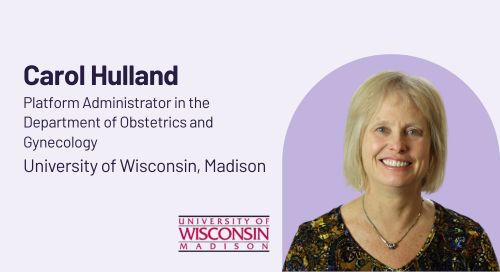
Discover how Carol Hulland, former Platform Administrator in the Department of Obstetrics and Gynecology at the University of Wisconsin-Madison’s School of Medicine and Public Health, transformed an isolated pilot project into a thriving, collaborative ecosystem. Originally highlighted during her session at Watermark Engage 2026, Carol faced the administrative challenges of managing diverse departmental requirements and tracking manual data across complex clinical and basic science career tracks. To overcome these hurdles, she spearheaded the creation of a cross-campus community of practice. By leveraging Watermark Faculty Success, her team has successfully eliminated duplicate data entry, reduced administrative burdens, and strengthened interdisciplinary advocacy needed to turn faculty accomplishment data into actionable insights.
We started with a six month pilot project in March of 2020, which included four departments in the School of Medicine and Public Health. All faculty in obstetrics and gynecology, plus about 40 others from three different departments so we’d have a good background of clinical and basic science faculty. To see how this worked, we entered five years of past data for everyone and started with a model of a CV report that had been developed by a different school at UW Madison using Faculty Success (formerly known as Digital Measures at that time).
After the pilot, my department continued using Faculty Success. We had an annual performance review platform that needed to be completely redeveloped, so one of the goals was to find ways to import an annual scholarly activity report into the system to ease the burden of creating the report every year. We also developed a CV report that meets our school’s requirements, developed guidelines for data entry, shared this with everyone who was involved in the pilot project and with school leadership advocating for use by all 20+ departments in the School of Medicine and Public Health.
From our education team, which tracks our medical students, residents and fellows educational activities, we’ve created a .csv report that can import the important data from their work directly into Faculty Success. From Faculty Success, we can gather the publication data, presentations and research support for grants and clinical activities. For example, an annual performance review report gets downloaded from Faculty Success and we provide data that goes to our Physician Activity Tracking (PAT) dashboard from Faculty Success. All of this data consistency is a big piece of the reduction of duplication.
All of our faculty have a proxy assigned to them who can help with the entry of data into Faculty Success. It’s certainly the faculty’s role to make sure that the data is accurate and complete, but it’s also helpful to have proxies who really understand the system and can help to ensure that data is consistent. And it’s really important to have consistent leadership for all of this. Our department champions and our Chair always reminds people of best practices. If the data isn’t in, it’s not going to get its credit. Also, we’ve realized you really need to have someone who has dedicated time for platform administration.
Our leadership is able to get timely comprehensive reporting for review and decision making. And over the 5-6 years that we’ve been using Faculty Success, we’ve found an increasing interest from our research quality and education teams requesting reports that also help with their own review and decision making. The streamlined workflows reduce administrative effort and manual processes. We used to have to do a lot of tweaking of the CV reports to get them into the promotion-ready format. Now, the Faculty Success report we’ve created has everything there, integrating our systems by pulling together our annual performance review position and scholarly activity tracking enhances the efficiency, user experience, satisfaction and success.
When I took over management of our Faculty Success platform, our client success manager introduced me to three or four other people across campus who were using Faculty Success, which was great. I didn’t know what I didn’t know until we met and started talking. About a year ago, we established a community of practice for Faculty Success administrators across UW Madison. At this point, there are 7 schools & colleges with Faculty Success. We meet about every two months and we find it’s very helpful. We work, learn from one another, find out what different schools are using it for…we’re advocating collectively with UW leadership to share our experiences.