
Wright State University is making efficiency soar
Institution Snapshot: Wright State University | Dayton, Ohio
Institution Type: Public 4-year university
Total enrolled students: More than 11,000
Total full-time faculty: ~500
Number of campuses: 2
Learn how to get change management right and give people their time back
Download Now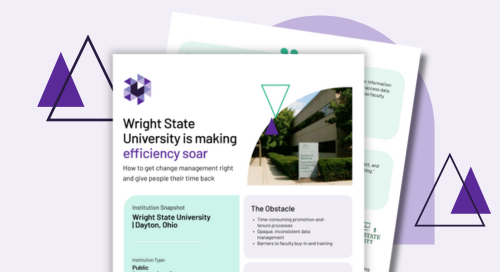

Wright State University in Dayton, Ohio, was founded on a legacy of innovation, independence, and an entrepreneurial spirit. Named after the pioneering Wright brothers who invented the airplane on a shoestring budget after repeatedly turning away funding opportunities that might hamper their freedom, Wright State University prides itself on offering an education that is both exceptional and affordable.
This pursuit of excellence is at the core of the university’s identity, which is how they came to find themselves in search of better software solutions to bolster their processes in 2023. They focused their efforts on streamlining promotion-and-tenure processes and complicated annual faculty reviews — made more complex by the university’s status as a collective-bargaining institution — as well as a decentralized data repository. All of this limited their outcomes and supersized administrative workload.
“Although we shared documents electronically, we were one step away from dragging huge piles of paper from office to office,” recalls Carol Loranger, PhD, Vice Provost for Faculty Affairs at Wright State University, who has been at Wright State University for over 30 years. They needed a flexible system that would allow them to not only solve problems in real time but also reflect on feedback for future improvements. Faculty members needed more nuanced career guidance and a simpler method for keeping their information up to date in a way that would support their long-term professional goals.
“Before Watermark Faculty Success, my office would have to remind, reformat, and gather information manually for a very important piece of a faculty member’s career. It’s nice to have easy-to-access data and formalized collective-bargaining-based prompts on what’s supposed to be submitted so faculty aren’t missing things.”
Carol Loranger, PhD
Vice Provost for Faculty Affairs
Wright State University
Hoping to streamline data collection and ensure consistent reporting, Wright State University turned to implementation of Watermark Faculty Success with the Review, Promotion, and Tenure (RPT) module. While the university had been using several other Watermark tools for years, Wright State had yet to tap Watermark’s dedicated faculty reporting software.
Elissa Falcone, MBA, Director of Curricular and Strategic Initiatives with the Office of the Provost at Wright State University, was appointed to oversee this enterprise-wide expansion together with Dr. Loranger.
After adding the new solution, Wright State University is benefitting from more efficient data collection and reduced administrative burden. They’re enjoying the ease of submitting documents and enforcing deadlines; the transparency of the system; the potential for time and money savings; and the ability to achieve consistency, clarity, and punctuality in reporting. They are also looking into the possibility of integrating their data with a public-facing scholars website that would help share their faculty’s research with a wider audience.
Though they are just in the first year of implementation, Wright State University has already noticed more efficient promotion-and-tenure processes. “Before Faculty Success, my office would have to remind, reformat, and gather information manually for a very important piece of a faculty member’s career,” notes Dr. Loranger. “It’s nice to have easy-to-access data and formalized collective-bargaining-based prompts on what’s supposed to be submitted so faculty aren’t missing things.”
“Time is the best thing we could give back to the faculty,” says Falcone, referring to the fact that, with Watermark, information only needs to be entered once and can be reused again and again for future reporting and promotion-and-tenure documentation. “The faculty members, especially those earlier in their careers, are building their dossiers from the minute they step on campus.”
“When we were implementing, the thing that we would say often was that it’s not going to be perfect, and that’s okay. But the Watermark system is really flexible. It’s like a box of Legos — we can build anything.”
Elissa Falcone, MBA
Director of Curricular and Strategic Initiatives with the Office of the Provost
Wright State University
How did they make it all work? Falcone and Dr. Loranger emphasize just how critical faculty buy-in is. It helped, they note, that the institution was already using several Watermark products, making the transition for those faculty members already familiar with Watermark even easier. “At the end of the day, you’re just managing change,” says Falcone. “As long as that’s the focus — to make sure something is positive and it’s a people-first process — that can be really helpful.”
Still, firm boundaries around the usage of a new software are central to a successful implementation. Falcone recalls that, with a previous implementation, “we were being a little too casual with participation.” That approach resulted in low adoption. From that experience, she learned the importance of having “a required piece that faculty could complete efficiently,” says Falcone.
Wright State University continues to aim for new heights: they hope to sharpen accreditation-report data and are considering expanding their use of RPT in Faculty Success to streamline additional workflows, such as for leave or professional sabbatical applications.
Integrating a large-scale system never comes without challenges. Teams must manage expectations and prioritize clear communication. “When we were doing implementation, the thing we would say often was that it’s not going to be perfect, and that’s okay,” says Falcone. “But the Watermark system is really flexible. It’s like a box of Legos — we can build anything.”