How Oklahoma Baptist University amplifies student voices to strengthen faculty development
Learn how Oklahoma Baptist University transformed course evaluations into a tool for students, faculty & administrators with Watermark.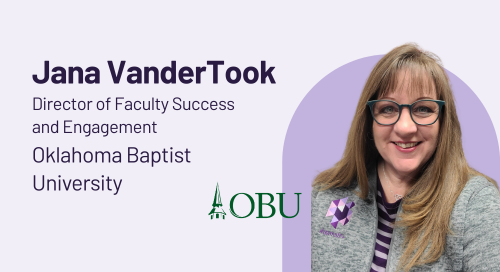
Like many institutions, Oklahoma Baptist University faced growing challenges with course evaluations, from low response rates and delayed results to a heavy administrative burden that limited the usefulness of student feedback. Faculty and administrators lacked timely, comprehensive data, and students had few opportunities to share their perspectives across all courses and instructors.
After implementing Watermark Course Evaluations & Surveys, OBU reimagined how student feedback could support teaching, faculty development, and institutional decision-making. Read more to hear from Jana VanderTook, Director of Faculty Success and Engagement at OBU.
Our response rates were low.
Our students were not able to speak into courses on a variety of levels taught by a variety of faculty.
Evaluation results were not available in a timely manner for faculty to consider and take action. Results would be returned up to five months following the semester. Faculty were not able to take action on course evaluation results.
The time needed to administer our course evaluations was immense. A staff member manually transferred all open-ended answers from the paper surveys to a document for distribution. This could take weeks. Course evaluations were not relevant for anyone—students, faculty, or administration.
From the way we had to structure our evaluations due to the cost of our prior tool, we did not evaluate every course. Senior faculty selected one course per term for evaluation. Junior faculty selected two courses. All adjuncts and first year faculty were evaluated in every course.
With the limited evaluations for our junior and senior faculty, the average number of full-time instructor-taught courses being evaluated was 30%. There was not enough data and the data was self-selected. Adjunct-taught courses being evaluated were utilized to assess only the teaching effectiveness of the adjunct. Full-time instructors selected the courses to be evaluated. There was no consistent or comprehensive evaluation of a subject or division/school. Student voices were lost in the lack of data.
We are now able to survey every class, every semester.
Students have a voice for all faculty, at every level of the university.
Our response rates now rest over 70% every semester.
Faculty can see real-time response rates for classes.
The software is integrated with Canvas! This integration is a positive for students who do not need to check email in order to find links to surveys. Reminders can be scheduled in Canvas as well as email.
Course evaluations results are now available at the end of each term after grades are submitted.
The report options include multiple formats speaking to the visual, mathematical, and statistical observer.
Faculty can use the information shared in the course evaluations to shape course design, curriculum, and organization before the next term begins.
Administration can use the information shared in the course evaluation to evaluate new faculty and adjuncts in a timely manner.
And finally, the time to administer course evaluations is a fraction of the time once spent. As the administrator, I am saving roughly 80% of the time it once took to administer course evaluations. If you consider the hourly savings, what used to take two weeks now takes two days.
OBU faculty use reports from CE&S as a part of their annual evaluations. Faculty are asked to reflect on patterns and strengths they see in the quantitative & qualitative responses given by students. Questions cover instructor preparation, organization, timely feedback, clear communication, encouraging student participation, learning activities and assignments, and integration of faith. Faculty are also asked to identify areas for improvement. Faculty recognize the value of student feedback. These annual reflections allow faculty to identify areas of improvement and take action before they reach the deadline for the promotion and tenure processes.
We have implemented three solutions with Watermark: Course Evaluations & Surveys (CE&S), Faculty Success (FS), and Planning & Self-Study (P&SS). In many ways, each implementation has been better than the last. The implementation team becomes a part of our campus during the intense training. I consider many of them friends. If I were speaking to someone before the implementation begins, I would advise them to make this implementation a priority on their calendar. Plan for times to work in the solution during the week. Make sure you think through your team to have multiple people trained in the solution alongside the lead administrator.
CE&S completely changed course evaluations. They are relevant on our campus, again and students know they have a voice. Thanks to this, we use CE&S to explore student ideas on success in the classroom and program needs. Student ideas for success are shared with incoming students or students taking a particular course. Student feedback on faculty is used to celebrate those who go over and above. Program ideas and needs are shared in budget meetings, donor conversations, and strategic planning.
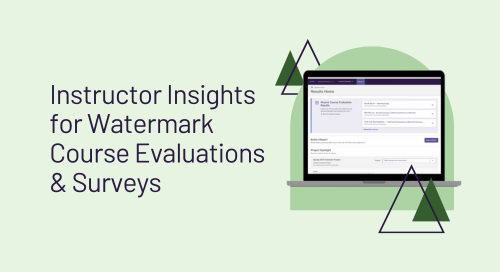
OBU is also in the process of adding Instructor Insights to CE&S. I see this feature strengthening the voice of students. Faculty will save time while gaining understanding and focus of the qualitative data. Effective action and improvement will follow the clarity provided by this tool. I can’t wait!
I can’t say enough good things about Watermark. There are so many positives in the solutions, implementation, and people that it is difficult to cover them all. Someone asked me recently if I knew of a good course evaluation software. Before I could say anything, they stopped me and noted that the look on my face said it all. They wanted to know more.


Browse our resource library
See how our tools are helping clients right now, get in-depth information on topics that matter, and stay updated on trends in higher ed.