Central Methodist University achieves institutional alignment through a unified software ecosystem
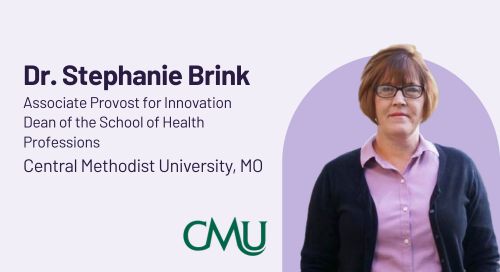
At Watermark’s 2026 Engage conference, Dr. Stephanie Brink, Associate Provost for Innovation and Dean of the School of Health Professions at Central Methodist University, shared her campus’s remarkable journey toward digital transformation. While introducing new software can often trigger institutional friction, CMU bypassed departmental silos by deploying the unified Watermark suite. Instead of treating curriculum, assessment, and student tracking as isolated tasks, Central Methodist utilizes Watermark as the central hub. In this Q&A, adapted from her presentation, Dr. Brink explains how Curriculum Strategy natively feeds into, complements, and elevates her other Watermark solutions to build a connected, data-informed campus
It’s really important to understand the culture at CMU. CMU is divided into two colleges, the College of Liberal Arts and Sciences, which is our main campus undergraduate programs, and then the College of Graduate and Extended Studies, which is everything else. That’s our locations across the state, our online programs, our prison education program, graduate programs—it’s basically anything that does not occur on our main campus. So we came into Curriculum Strategy with three catalogs, one for our main campus, one for statewide and online undergraduate, and one for our graduate catalog. So for curriculum management, we have different governance structures for the different colleges and we had to set up programs that were specific to each college.
When we went live, we had to say “No, you can’t use that piece of paper or email anymore. You need to do that in Curriculum Strategy”. That was the pain point because, as everybody knows, change is hard, especially when there are multiple changes coming at one time. Since I frequently hear “Why can’t I just do it the old way?” (not just with this product, but with anything), and because we had so many products coming at them at once, I sit in a committee meeting and say, “Well, we could do that with Watermark too.”
Curriculum Strategy (CS) has a comprehensive listing of all programs and courses at CMU. For General Education, there are so many possibilities as it relates to courses, CS helps the team maintain organization. In addition to CS, System Administration allows for the exporting of program curriculum if it is built in the system for Planning & Self-Study (P&SS).
I’m also going to be using CS with Student Success & Engagement for getting our academic planning set up because we have already built those plans in CS. I also utilized CS to help me in system administration to build the curriculum for P&SS and Student Learning & Licensure. So it all flows together. The way these products intertwine is amazing, and I am sure we have not yet scratched the surface.
I have seen faculty use the new AI features (in Course Evaluations & Surveys and Planning & Self-Study) to reduce tedious tasks and to explore gaps and actions that they had previously missed. With our General Education assessment in Student Learning & Licensure, we are able to incorporate all undergraduate students and dual credit. We can view them as a whole, or break them down into location and/or delivery method. It has been interesting to see the results of assessment across the entire university without having to struggle collecting the correct data at the correct time from the correct people.
I initially turned on the AI-powered CV Imports feature in Faculty Success for a small group to pilot to see what their thoughts were. They loved it. They said it was much easier uploading a CV than previously. I have been showing faculty Planning & Self-Study. I had a conversation with the director of my athletic training program and he said he loved it. He said [when he tried it], he was working on his assessment for the year and when he pulled it up he wasn’t expecting it to be 100% spot on. He was expecting to have to make a lot of changes, but when he read it, there were just a few slight changes that he had to make. He said it was really nice how it pulled all of his data together in a meaningful narrative that would have taken him hours and hours to write.