Higher education effectiveness has long been tied to accreditation cycles and compliance checklists. While these remain essential, they are no longer sufficient. Today, leaders must navigate dwindling resources and tighter budgets while meeting rising demands for transparency and measurable outcomes.
That pressure has led campuses to revisit a basic question: What is institutional effectiveness in higher education today?
In Watermark’s Institutional Effectiveness (IE) webinar series, featuring leaders from the University of Arizona, University of Southern Mississippi, Embry-Riddle Aeronautical University, and Howard University, institutional effectiveness is shifting from proving compliance to demonstrating impact. Success now means leveraging assessment, data, and technology to drive student outcomes and align strategy with mission.
The following takeaways reflect key themes from IE leaders and provosts, outlining what is changing, what is working, and where to focus next.
1. Assessment is shifting from compliance to continuous improvement
A core theme from the series was the reframing of assessment from a periodic accreditation hurdle to an ongoing practice of continuous improvement. When assessment data informs regular academic and operational dialogue, it evolves from a reporting obligation into a vital tool for learning and decision-making.
To achieve this at scale, institutions are increasingly adopting systems like Planning & Self-Study to unify assessment, accreditation, and institutional strategy.
An assessment of best practices in higher education reveals that institutions embedding assessment in day-to-day work are better positioned to:
- Spot trends earlier
- Respond proactively to challenges
- Demonstrate meaningful progress to accreditors
In this context, assessment and accreditation in higher education become mutually reinforcing rather than competing priorities.
Takeaway
Leaders are shifting assessment from a chore to a strategy. By integrating it into existing meetings and reviews, we can highlight faculty impact and strengthen student outcomes without adding to the workload.
A simple first step:
Review your next assessment communication. Does it lead with student impact or compliance deadlines?
2. Technology is enabling institutions to do more with less
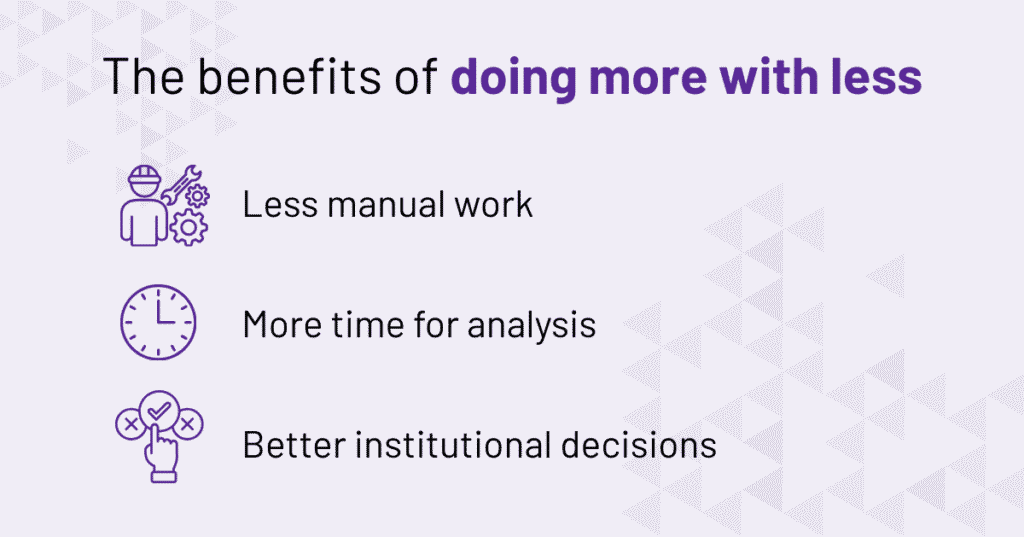
Resource constraints were a recurring reality across the webinars. Many institutions described how technology is helping them maintain rigor and accountability without overloading faculty and staff.
Modern assessment systems for continuous improvement reduce dependence on manual processes, spreadsheets, and disconnected tools. By automating collection, standardizing workflows, and centralizing evidence, institutions can:
- Free up faculty and staff time
- Cut down on duplicated effort
- Improve consistency across units
This “do more with less” approach enables teams to focus on analysis and action rather than administrative work.
Takeaway
Effective technology turns paperwork time into improvement.
A simple first step:
Ask one department how they actually experience your assessment system. Their answer will tell you whether it feels empowering or transactional.
3. Student-centered assessment practices are gaining momentum
Another key theme was the increasing focus on student-centered assessment. Institutions are moving beyond aggregate outcomes to ask deeper questions:
- Who is being served well?
- Where are disparities emerging?
- How can assessment inform stronger learning experiences?
Participants emphasized using disaggregated data and intentional assessment to connect results to student experiences. By identifying exactly which students are thriving and which may need additional support, institutions can target improvements effectively, shifting the focus of institutional effectiveness from compliance to student success.
Takeaway
Success isn’t just about a school’s overall results; it’s about ensuring every student is learning and progressing. Assessment teams reframed their messaging to tie every conversation back to student growth, institutional mission, and closing performance gaps.
A simple first step:
At your next data review, require one question about student performance patterns before discussing compliance metrics.
4. One-size-fits-all assessment doesn’t work
The webinar series highlighted that rigid, one-size-fits-all assessment models often fail to account for institutional complexity and disciplinary nuances.
Effective frameworks strike a balance between:
- Institutional consistency
- Departmental flexibility
Leaders shared how adaptable systems allow academic units to assess what matters most to them while still contributing to institution-wide insight. This balance increases participation and improves data quality, both critical for sustainable assessment.
Takeaway
Leaders described honoring faculty expertise and allowing units to own their assessment design. When you give departments the freedom to measure what matters most in their specific field, they are much more likely to participate and provide better information. Effective systems provide guardrails, not rigid scripts.
A simple first step:
Review one institutional assessment template with a small faculty group. Ask what feels helpful and what feels overly restrictive. Use that feedback to refine expectations.
5. Faculty buy-in is the foundation of sustainable assessment
No assessment plan works without faculty engagement. Speakers repeatedly noted that faculty buy-in grows when the work is clear, relevant, and respectful of their time.
Institutions that are having success with assessment typically:
- Clearly articulate why assessment matters
- Show how data shapes decisions about teaching and learning
- Offer tools that simplify, not complicate, faculty work
When faculty see assessment as meaningful insight rather than performative, participation rises, and the quality of results improves.
Takeaway
A recurring theme was shifting from “arbiters of assessment” to consultants and collaborators. Assessment leaders met regularly with units, translated processes clearly, and highlighted faculty efforts that previously went undocumented.
A simple first step:
Publicly recognize one example of meaningful assessment work this semester.
6. Centralized data unlocks deeper institutional insight
Many institutions struggle not because they lack data, but because they lack integration. A major takeaway from the series was the power of centralized data for institutional insight.
When assessment, accreditation, and planning data are connected, leaders gain:
- A more complete view of institutional performance
- The ability to identify cross-functional trends
- Greater confidence in strategic decisions
This centralized approach strengthens institutional effectiveness in higher education by turning fragmented information into actionable intelligence.
Takeaway
Data is only “intelligence” when it’s connected. Centralization should improve clarity, not just storage.
A simple first step:
Identify one strategic goal and trace which systems contain related data. If the information lives in more than two disconnected places, integration may be limiting insight.
7. AI is changing how faculty engage with feedback
Artificial intelligence surfaced as a forward-looking theme across the series. Institutions are beginning to explore how AI can support, not replace, faculty judgment.
Examples included:
- AI-assisted feedback to help faculty respond more efficiently
- Pattern recognition to surface common themes in assessment results
- Support for drafting narratives and reports that faculty can refine
Used thoughtfully, AI can reduce time spent on repetitive tasks and free faculty to focus on high-impact teaching and mentoring.
Takeaway
AI isn’t there to grade students or replace professors. It’s there to clear the busy work off their desks.
A simple first step:
Pilot AI support in one limited, clearly defined area (e.g., summarizing feedback themes), then gather faculty input before expanding.
8. Promotion and tenure processes are becoming more transparent and efficient
Beyond assessment, the series also highlighted growing attention to promotion and tenure processes. Institutions are recognizing that clear criteria and consistent processes are essential for trust.
Technology-supported workflows help institutions:
- Standardize documentation
- Provide better visibility into progress
- Reduce administrative bottlenecks and confusion
This transparency helps build faculty confidence and reinforces the institution’s commitment to fair and accountable evaluation.
Takeaway
By making the promotion process transparent and digital, schools build trust with their teachers and ensure that hard work is rewarded fairly and on time.
A simple first step:
Survey recently promoted faculty about points of confusion in the process. Use their feedback to clarify guidance or improve workflows.
9. Collaborative rubric development drives alignment and buy-in
Rubrics frequently emerged as a practical tool for alignment. When rubrics are developed collaboratively, they help create a shared understanding of expectations across programs and departments.
Institutions reported that collaborative rubric work can:
- Improve consistency in how work is evaluated
- Supports richer, more targeted feedback
- Builds faculty ownership of assessment outcomes
Well-aligned rubrics tie learning outcomes to evidence in ways that are both rigorous and usable.
Takeaway
Collaboration transforms rubrics from compliance artifacts into teaching tools.
A simple first step:
Host one cross-department session to review and refine a shared rubric. Focus on clarity and alignment to learning outcomes.
10. Leadership and policy support accelerate institutional change
Finally, the webinars reinforced that lasting institutional effectiveness depends on visible support from leadership. When presidents, provosts, and academic leaders champion assessment and improvement, efforts gain traction.
Effective leaders tend to:
- Align policies with assessment goals
- Invest in systems that support long-term improvement
- Use data to guide (not just justify) decisions
Leadership commitment signals that institutional effectiveness is a strategic priority, not a compliance exercise.
Takeaway
Leaders who model data-informed decision-making signal that impact matters.
A simple first step:
At your next cabinet meeting, ask: “What recent decision was directly informed by assessment evidence?”
Turning insight into impact
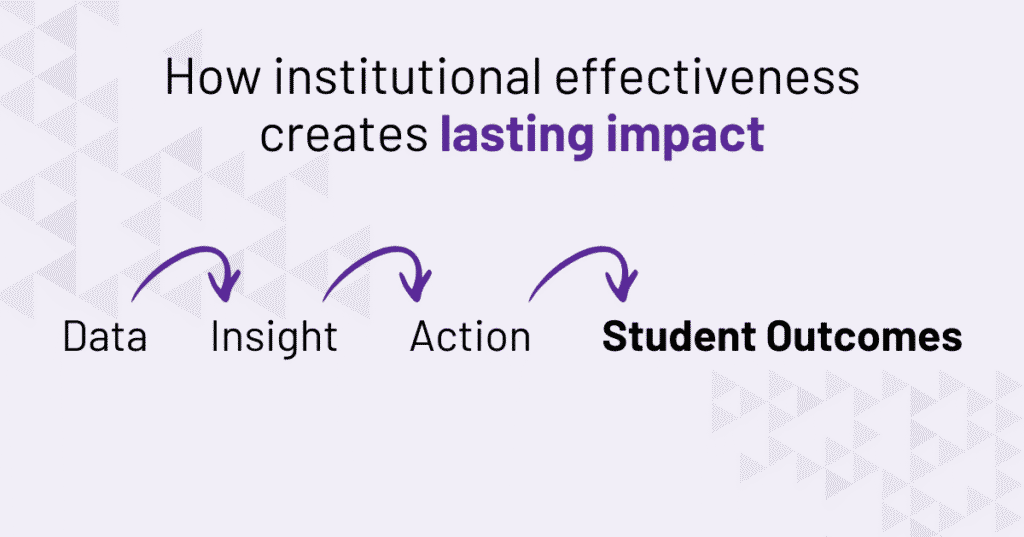
Watermark’s webinar series delivered a clear message: institutional effectiveness is evolving beyond static reports and accreditation cycles. Today, it is defined by an institution’s ability to demonstrate impact, adapt, and improve.
By adopting modern practices, leveraging technology, and fostering campus-wide collaboration, institutions can shift from compliance to impact, turning effort into evidence and evidence into action. The ultimate challenge is no longer proving that assessment matters, but ensuring the systems, culture, and leadership are aligned to make it matter consistently.
To see how Watermark supports this work, request a demo and explore how our solutions can help higher education leaders do more with less while clearly demonstrating their impact.