The community college dropout rate refers to the percentage of students who leave college before completing a credential or degree. According to the National Center for Education Statistics (NCES), about 34% of first-time, full-time students at two-year institutions complete a credential within 150% of their program’s expected completion time, highlighting the importance of student retention and persistence efforts. (1)
Community college students often balance coursework with work, family, and financial responsibilities, making persistence more challenging than simply staying enrolled. Understanding the community college dropout rate and the factors that contribute to stopped-out students can help institutions improve student success, reenrollment, and long-term retention.
This guide explores common causes of student withdrawal, strategies for reengaging stopped-out students, and practical ways institutions can strengthen student retention and persistence.
Understanding the community college student experience
Community colleges serve students with a wide range of educational goals, life experiences, and support needs. Understanding these varying needs is critical to creating effective support systems and improving student persistence.
For example, there are:
- adult learners
- dual-enrollment students
- first-generation students
- working students
- transfer-focused students
- student parents
- career changers
Not all students are traditional-age students preparing for a career path or working toward a bachelor’s degree. Some students are earning college credit while still in high school, some are preparing to transfer to a four-year institution, and others are balancing college alongside careers and family responsibilities.
Common causes of community college student withdrawal
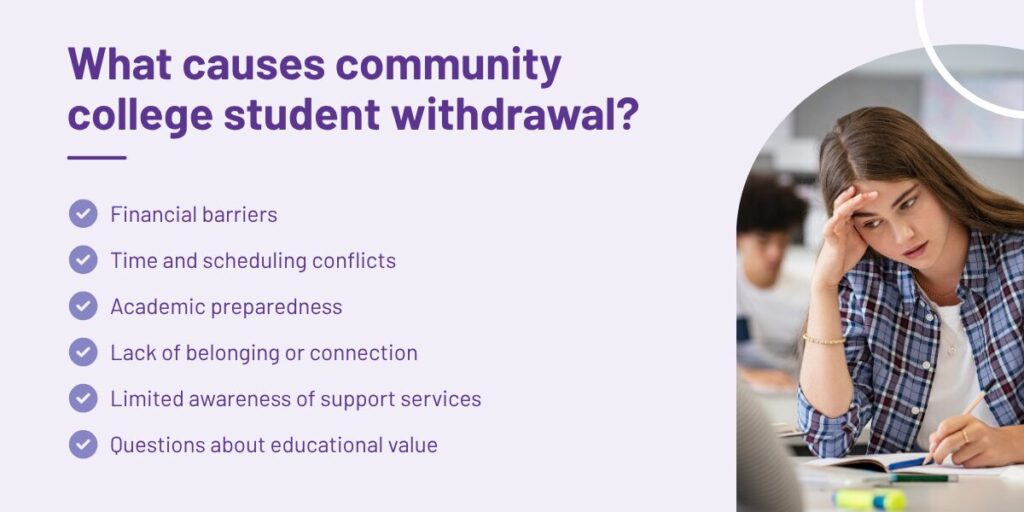
Community college students stop out for many reasons, ranging from financial challenges to scheduling conflicts and lack of support. Understanding these barriers can help institutions develop more proactive student success and retention strategies.
Financial barriers
Financial pressure remains one of the leading reasons students leave community college. Tuition, books, transportation, housing, childcare, and living expenses can quickly become difficult to manage, especially for students working while enrolled.
Many community college students are financially independent or supporting family members while attending school. Even with financial aid, unexpected expenses can interrupt enrollment momentum and make reenrollment difficult.
Time and scheduling conflicts
Many students attend community college while balancing full-time jobs, caregiving responsibilities, or family obligations. Rigid schedules and limited course availability can create barriers for students trying to fit education into already demanding lives.
Working adult learners and student parents may struggle to attend classes consistently if institutions do not offer flexible scheduling options, evening courses, hybrid learning opportunities, or online support services.
Academic preparedness
Community colleges serve many students with varying levels of academic preparation. Some may need developmental coursework, tutoring, or additional advising support before transitioning successfully into college-level academics. (2)
Without timely support, students who feel overwhelmed by coursework may become disengaged and fall behind academically.
Lack of belonging or connection
Student engagement and belonging can significantly impact persistence. Students who feel disconnected from peers, faculty, advisors, or campus life may be more likely to stop attending classes or withdraw altogether. This challenge can be especially significant for commuter students, adult learners, part-time students, first-generation students, and online learners. Building stronger connections across the student experience can help students stay enrolled.
Limited awareness of support services
Some students are unaware of the support services available to them, including:
- tutoring
- mental health services
- academic advising
- financial aid guidance
- career services
- transfer support
When students do not know where to turn during moments of difficulty, small challenges can escalate into enrollment interruptions.
Questions about educational value
Some students question whether continuing college is worth the time and financial investment, particularly when they face immediate workforce demands or uncertainty about their long-term goals. If students don’t see a clear connection between their coursework and future opportunities, they may be more likely to disengage or pause their education.
As interest in trade careers and direct workforce entry grows, community colleges increasingly need to help students understand how their educational experience supports:
- workforce readiness
- transfer opportunities
- credential completion
- career mobility
Helping students connect coursework to their academic, transfer, and career goals can strengthen motivation and support persistence toward completion.
Reengagement strategies for stopped-out community college students
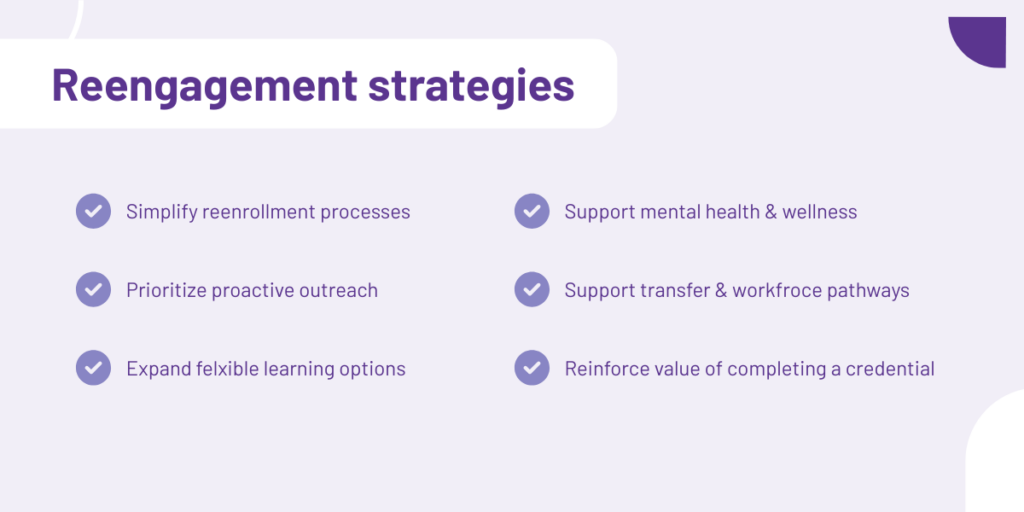
Reengaging stopped-out students requires institutions to reduce barriers, simplify reenrollment, and provide coordinated support throughout the student journey.Expa
Simplify reenrollment processes
Returning students often face administrative barriers when attempting to reenroll. Community colleges can improve reenrollment by:
- streamlining registration steps
- simplifying financial aid processes
- offering clear transfer credit guidance
- improving communication with returning students
For example, institutions can create dedicated reenrollment webpages, provide step-by-step enrollment checklists, offer one-on-one advising appointments for returning students, and use personalized outreach campaigns to guide students through registration and financial aid requirements. Colleges may also consider reviewing institutional policies that create unnecessary barriers, such as complex reapplication procedures or unclear transfer credit evaluations.
Reducing friction during reenrollment can help students regain momentum more quickly and increase the likelihood that they return to complete their educational goals.
Prioritize proactive outreach
Consistent outreach helps institutions identify and support students before they stop out. Early alerts, advising check-ins, and student engagement data can help colleges prioritize interventions and strengthen advising effectiveness. Watermark Student Success & Engagement supports these efforts by improving visibility into student needs and coordinating support across teams.
Expand flexible learning options
Flexible scheduling can help students continue progressing toward completion while balancing outside responsibilities. Community colleges may improve persistence by offering:
- evening classes
- weekend courses
- hybrid learning
- online learning opportunities
- accelerated formats
- asynchronous teaching
Flexible options can be especially valuable for working adult learners and student parents.
Strengthen mental health and wellness support
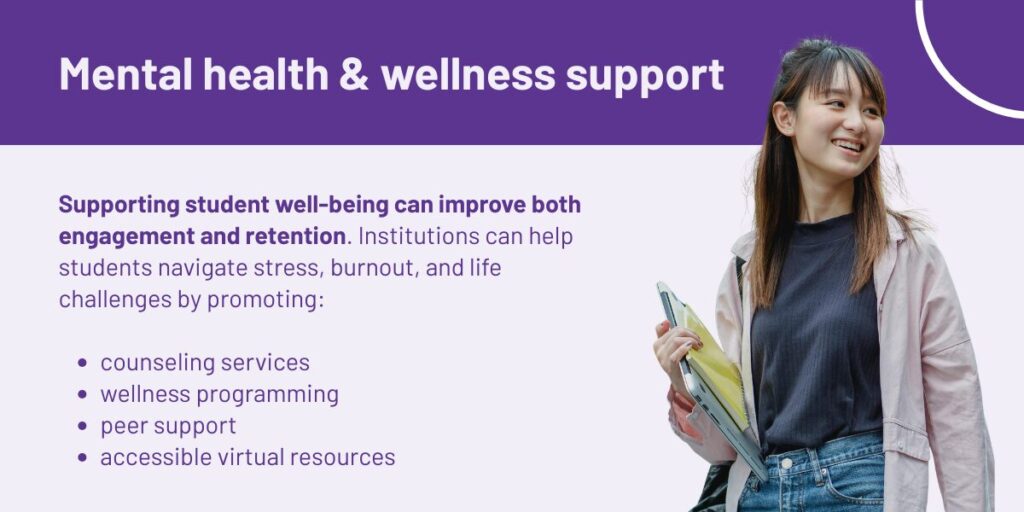
Supporting student well-being can improve both engagement and retention. Institutions can help students navigate stress, burnout, and life challenges by promoting:
- counseling services
- wellness programming
- peer support
- accessible virtual resources
To increase awareness, institutions can promote wellness resources through orientation programs, advising interactions, email and text campaigns, learning management systems, and campus events. Regular communication can help students understand what support is available and how to access it when needed.
Creating a supportive campus culture can help students feel more connected and more likely to persist.
Support transfer and workforce pathways
Many community college students enroll with specific transfer or workforce goals in mind. Institutions can improve student engagement by helping learners clearly understand:
- transfer agreements
- career pathways
- credential progression
- workforce opportunities
- academic planning expectations
Colleges can support these efforts by providing clear degree maps, offering proactive academic advising, connecting students with career services, and regularly communicating transfer requirements and workforce opportunities. Partnerships with four-year institutions and local employers can also help students better understand how their coursework aligns with future educational and career goals.
Reinforce the value of completing a credential
Students who stop out may question whether continuing their education aligns with their personal, academic, or career goals. To support reenrollment efforts, community colleges can regularly evaluate programs, assess student needs, and adapt offerings to reflect changing workforce expectations and transfer opportunities.
Clearly communicating the value of credential completion can help students understand how their education supports future goals. Highlighting academic pathways, flexible learning options, transfer opportunities, and student success outcomes can help reinforce the benefits of returning and completing a program.
Retention solutions for community colleges
Reducing the community college dropout rate requires coordinated institutional strategies that support student success across academics, advising, engagement, and curriculum planning.
Use data to build student-centered retention strategies
Reducing dropout rates requires shifting from reactive problem-solving to proactive, data-driven intervention. By centralizing engagement, attendance, and academic performance indicators, institutions can identify common institutional barriers and spot struggling students before they disengage completely.
For example, when automated system insights flag a sudden decline in assignment submissions or a drop in LMS login activity, advisors can immediately deploy targeted outreach tailored to that student’s specific risk factors. Leveraging real-time data allows cross-functional teams to prioritize workloads, close communication gaps, and provide timely support that keeps diverse student populations moving toward completion.
Build connected student support systems
Community college students often need support across multiple areas simultaneously, including academics, finances, mental health, and career planning.
Cross-functional collaboration between advising, academic affairs, financial aid, and student support teams can help students access support more easily.
Improve academic pathway clarity
Students are more likely to persist when they clearly understand course sequencing, transfer requirements, and degree progression.
Institutions can improve retention by:
- reducing curriculum complexity
- improving pathway visibility
- aligning programs with workforce and transfer goals
- helping students stay on track toward completion
Watermark Curriculum Strategy supports institutions with curriculum visibility, academic planning, and pathway alignment to help students stay on track toward completion.
Increase student engagement and belonging
Retention improves when students feel connected to their institution. Colleges can strengthen belonging through:
- orientation programs
- peer mentorship
- student organizations
- faculty engagement
- personalized advising
Because community colleges serve students with a wide range of educational goals, life experiences, schedules, and support needs, institutions may also consider creating opportunities specifically designed for working adults, student parents, first-generation students, part-time learners, and online students. Examples include flexible engagement opportunities, virtual communities, peer support networks, targeted student success programs, and events scheduled outside traditional daytime hours.
Regular advisor check-ins, faculty outreach, and peer support networks can help students build meaningful connections, even if they spend limited time on campus. Community-building efforts can help students stay connected and supported during challenging periods.
Frequently asked questions about community college dropout rates
What contributes to the community college dropout rate?
Community college students may stop out due to financial pressures, work responsibilities, caregiving demands, academic challenges, mental health concerns, or lack of support resources. Many students leave temporarily and later re-enroll once barriers are reduced.
What helps improve community college retention?
Effective retention strategies often include proactive advising, early intervention, flexible scheduling, mental health support, financial assistance, student engagement initiatives, and clear academic pathways.
How can colleges reengage stopped-out students?
Community colleges can improve reenrollment by simplifying administrative processes, conducting proactive outreach, improving advising support, and helping students reconnect to academic and career goals.
Why is student engagement important for retention?
Students who feel connected to peers, advisors, faculty, and campus resources are often more likely to persist through challenges and continue progressing toward completion.
Improve student success and retention with Watermark
Improve student retention and persistence with a centralized student success solution. Request your live demo today to see how Student Success & Engagement (SSE) helps community colleges coordinate outreach, advising, and support services in one place.
References
- National Center for Education Statistics. Undergraduate Retention and Graduation Rates. U.S. Department of Education, Institute of Education Sciences. https://nces.ed.gov/programs/coe/indicator/ctr
- Community College Research Center. Developmental Education. Teachers College, Columbia University. https://ccrc.tc.columbia.edu/research/developmental-education.html