Key themes from HLC 2026
Building a sustainable future through change management
Across Higher Learning 2026 discussions, several consistent themes emerged around how institutions are adapting to increasing complexity while maintaining alignment, accountability, and student outcomes. These takeaways reflect a shift toward more intentional, connected approaches to operations:
- Structured change management: Institutions are prioritizing long-term strategy, reducing complexity, and using data to guide decisions, with AI supporting, not replacing human judgment.
- Continuous accreditation readiness: Shift toward ongoing documentation, cross-department alignment, and continuous improvement over cyclical preparation.
- Data-driven student success: Focus on connecting data to action by reducing silos and linking insights directly to outcomes and decision-making. Focus on connecting data to action by reducing silos and linking insights directly to outcomes and decision-making.
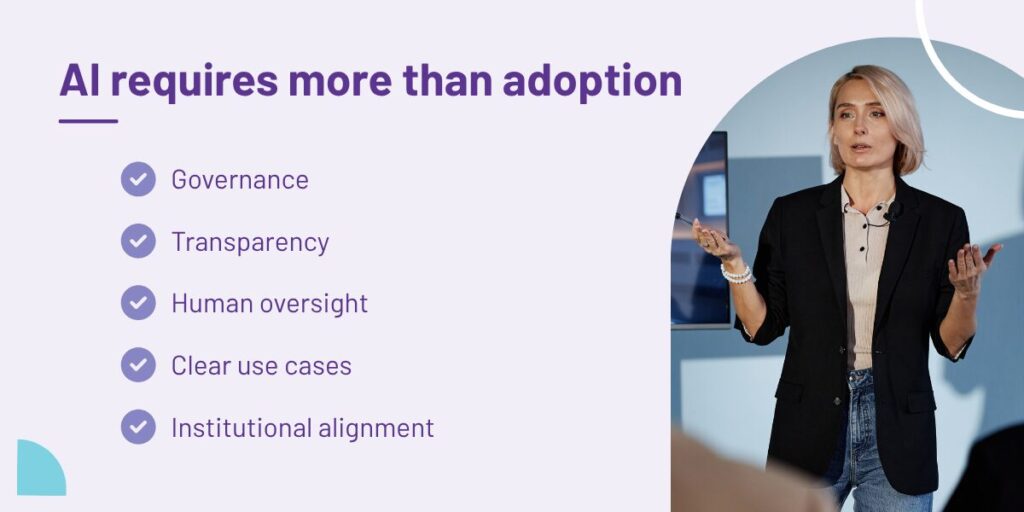
- AI governance in higher ed: Emphasis on responsible use, transparency, and oversight, with AI supporting efficiency while remaining human-led.
What this means for institutions
These takeaways highlight a broader operational shift across higher education.
Scaling reporting and compliance: Institutions need consistent, scalable systems to meet growing accreditation demands.
Using data for improvement: Focus is shifting from reporting data to actively using it to inform decisions.
Managing complexity: Institutions are prioritizing more intentional approaches to handle increasing operational complexity.
How to take action
For institutions looking to apply these insights in practice, several actionable approaches stand out:
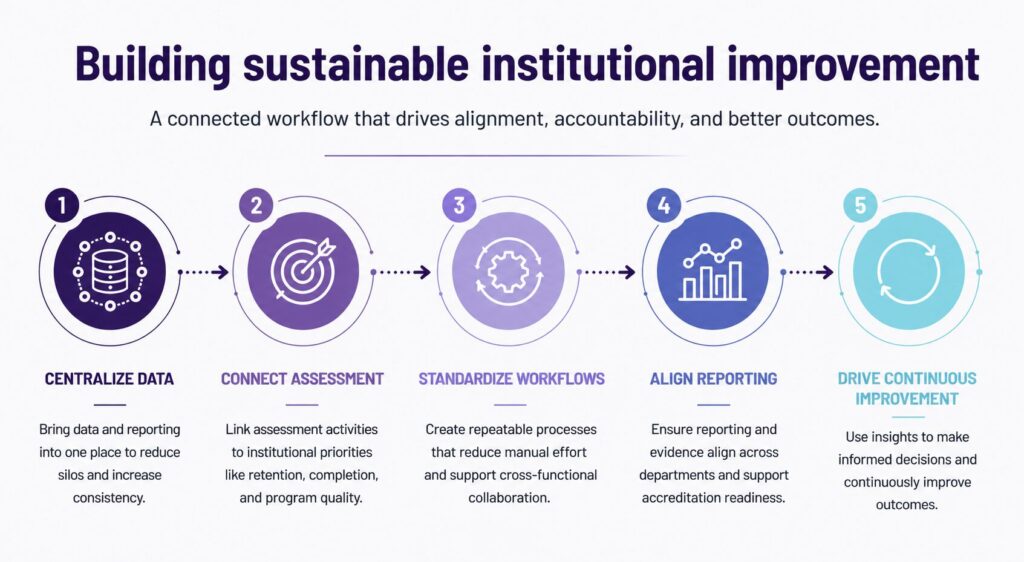
- Centralize reporting: Bringing data and reporting into one place helps reduce duplication and improve consistency across departments.
- Connect assessment to institutional priorities: Assessment work becomes more valuable when it clearly ties to goals like retention, completion, and program quality.
- Be intentional about AI use: AI can support analysis and efficiency, but it requires clear boundaries, governance, and defined use cases.
- Build repeatable processes: Repeatable workflows reduce reliance on manual effort and make it easier to maintain progress over time.
How Watermark helps
Watermark supports institutions working through these challenges by bringing structure and visibility to key processes.
With a more connected approach, institutions can:
- Manage accreditation reporting and documentation more consistently.
- Connect assessment work to institutional goals.
- Improve visibility into outcomes and performance.
- Support ongoing improvement through shared workflows.
The focus is not on adding new processes, but on making existing ones easier to manage.
The Higher Learning Commission reflected a shift already underway across higher education. Institutions are being asked not only to do more, but to demonstrate how they’re doing it and what is changing as a result. That makes alignment across data, systems, and strategy more important than ever.
Learn how Watermark supports continuous improvement and helps institutions strengthen accreditation readiness.