Most conversations about AI in higher education tend to bounce between extreme techno-optimism and apocalyptic panic. As Senior Vice President of Product at Watermark, I spend my days living in the space right between those two poles: operational reality.
Navigating AI entails understanding how technology integrates into complex academic workflows, respects institutional data governance, and ultimately frees up human beings to do what they do best: teach, mentor, and lead.
To help provosts, chief academic officers, deans, and ed tech builders filter out the noise, I’ve put together a curated look at what I’m reading, listening to, and watching. This list of AI resources balances core product and tech strategy with the higher education perspectives that institutional leaders and technologists need to drive meaningful change.
Learn more about Watermark’s AI solutions
What I’m listening to: Strategy, product mechanics, and higher ed reality
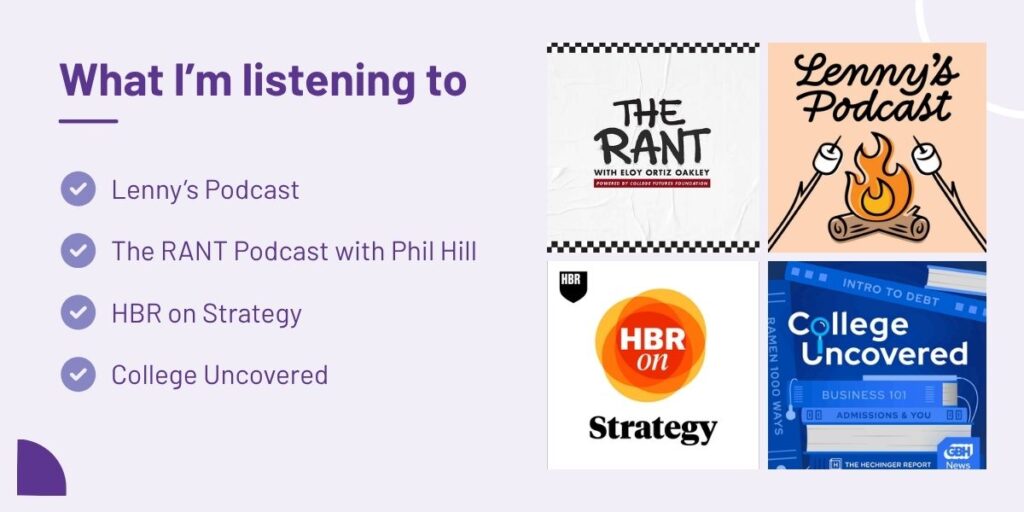
- The Angle: Product management, growth, and building modern software.
- Why it’s worth your time: While geared toward product leaders, Lenny’s Podcast deep dives into how tech gets built—and how user behavior actually shifts—are essential for anyone evaluating SaaS tools. It’s a masterclass in separating product mechanics from market marketing.
The RANT Podcast featuring Phil Hill
- The Angle: Strategic ed tech analysis and honest higher education commentary.
- Why it’s worth your time: Phil Hill brings zero fluff to higher education technology. Episodes like “Earnings Premium Under the Microscope” get straight to the heart of academic portfolio management, program ROI, and how institutions must adapt to emerging accountability frameworks.
- The Angle: High-level organizational leadership and strategic execution.
- Why it’s worth your time: AI transformation isn’t a software problem; it’s a change management problem. HBR provides the conceptual scaffolding needed to lead teams through structural disruption without losing sight of institutional mission.
- The angle: Demystifying the inner mechanics and economics of higher education.
- Why it’s worth your time: A great reminder of the daily realities facing students and administrators. Grounding technical innovation in real-world institutional mechanics keeps our AI roadmaps aligned with actual campus needs.
What I’m reading: Grounded frameworks for responsible AI
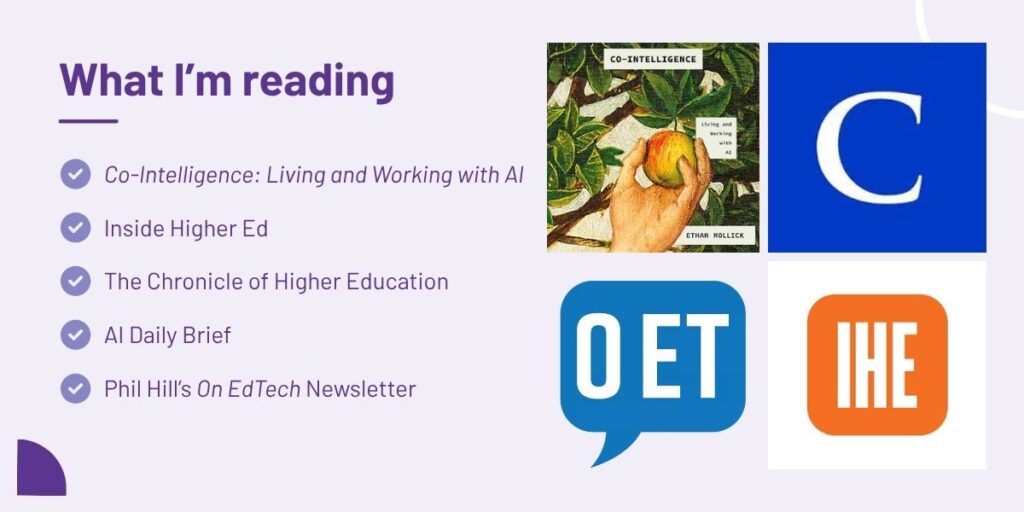
Co-Intelligence: Living and Working with AI by Ethan Mollick
- The Angle: Practical, human-in-the-loop co-existence with generative tools.
- Why it’s worth your time: Mollick, a professor at Wharton, writes with refreshing clarity on how AI acts as a thought partner rather than a replacement. His perspective aligns closely with our product philosophy at Watermark: technology should eliminate monotonous tasks and amplify human judgment, not automate away the core educator-student relationship.
Inside Higher Ed & The Chronicle of Higher Education AI Coverage
- The Angle: Trend reporting, policy tracking, and campus case studies.
- Why it’s worth your time: Key pieces like “The Rise of the Agentic AI University in 2026” (Inside Higher Ed) and our recent joint report, the CHE x Watermark AI Insights Report, highlight a critical trend: while campuses are eager for backend efficiency, trust drops off when AI encroaches on core pedagogy. These publications are vital for staying ahead of campus sentiment.
AI Daily Brief & Phil Hill’s On EdTech Newsletter
- The Angle: Daily market intelligence and sector-specific breakdown.
- Why it’s worth your time: The AI Daily Brief gives you the high-level macro shifts in generative tech, while Phil Hill synthesizes what those shifts actually mean for campus budgets, vendor ecosystems, and academic governance.
Who I’m following: Industry voices and thought leaders

Phil Hill: The market analyst higher ed leaders turn to for sharp, no-nonsense commentary on learning management systems, vendor landscapes, and technology strategy.
Justin Menard (ListEdTech): The go-to source for raw, data-driven EdTech market trends and institutional stack shifts.
Simon Sinek: A vital voice on leadership, vision, and keeping human purpose at the center of rapid technological evolution.
Lex Fridman: Deep-dive, technical conversations with the pioneers shaping foundational AI architecture and philosophy.
Ethan Mollick: A Wharton professor breaking down practical generative AI use cases, human-AI collaboration frameworks, and the real-world impact on teaching and work.
The Watermark take: AI built for purpose
When we evaluate AI at Watermark, we ask a simple question: Does this give academic leaders their time back?
Whether we’re embedding context-aware AI into Course Evaluations & Surveys or streamlining accreditation narrative mapping in Planning & Self-Study, our commitment remains fixed:
- Total transparency: Clear, traceable evidence behind every output.
- Granular control: Giving institutions immediate authority to toggle features to match their policy maturity.
- Strict guardrails: Keeping humans “on the loop” to preserve institutional context and personal connection.
Building responsible AI governance into your technology strategy requires clear oversight, transparent data practices, and direct alignment with institutional values. Balancing institutional AI governance responsibilities with student success doesn’t happen overnight. Download our comprehensive framework, A maturity model for responsible AI in higher education, to help your leadership team navigate the stages of institutional readiness and turn AI experiments into sustainable strategy.