Accreditation plays a critical role in helping community colleges demonstrate educational quality, support student success, and maintain access to federal financial aid. However, preparing for a review looks vastly different at a two-year institution compared to a traditional four-year university.
While the overarching goals are consistent, there is no single, uniform accreditation process for schools. Two-year institutions must routinely balance academic transfer pathways alongside fast-moving, workforce-focused career and technical education (CTE) programs. Navigating this complexity requires a strategic approach to data collection and reporting.
This guide explores common accreditation challenges facing community colleges and shares strategies for simplifying accreditation management and supporting year-round readiness.
The accreditation landscape: Institutional vs. programmatic review
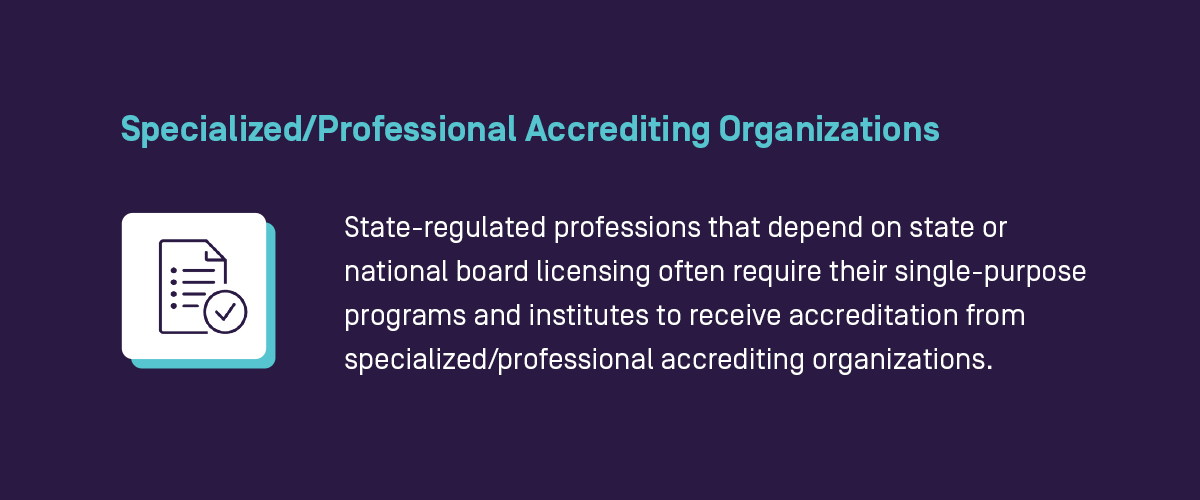
Community colleges operate in a unique, dual-reporting environment. Institutional accrediting organizations evaluate the institution as a whole, while specialized bodies review individual clinical, technical, or workforce programs. For two-year schools, maintaining institutional quality requires aligning processes with the specific criteria of recognized regional bodies, including:
- ACCJC (Accrediting Commission for Community and Junior Colleges)
- HLC (Higher Learning Commission)
- SACSCOC (Southern Association of Colleges and Schools Commission on Colleges)
- MSCHE (Middle States Commission on Higher Education)
- NWCCU, NECHE, and WSCUC (Regional bodies evaluating western, northwestern, and New England institutions within the explicit context of their local campus missions.)
While the core evaluation criteria of these organizations overlap, the operational reality of meeting them looks vastly different at a two-year campus:
| Evaluation area | Traditional 4-year focus | Community college reality |
| Faculty demographics | Primarily full-time, tenured faculty ties to long-term committee workflows | Heavy reliance on adjunct faculty (50-70%) who have limited involvement in self-study committees |
| Program diversity | Standardized academic degrees and multi-year research tracks | Mix of transfer tracks, short-term workforce certificates, adult education, and CTE programs |
| Data aggregation | Longitudinal program-level data points collected over multi-year cycles | Fast-moving enrollment shifts requiring immediate course-to-program roll-ups. |
Step-by-step accreditation process for schools
Step 1: Review accreditation standards and regional requirements
The accreditation process begins with a deep, intentional review of the criteria established by your specific accrediting body. Most regional agencies evaluate core pillars such as mission alignment, academic quality, governance, and financial sustainability. For community colleges, this foundational phase must look beyond standard metrics to explicitly account for variables unique to two-year operations—including regional workforce development programs, CTE tracks, and credit transfer articulation agreements
Step 2: Create an accreditation checklist
Before diving into evidence collection, successful institutions shift from theoretical standards to operational planning. Because community colleges run on lean administrative teams and rely heavily on a transient adjunct faculty base, you need a structured internal framework to protect version control and maintain momentum. Before moving forward, ensure your team has checked off these foundational logistics:
- Map your accrediting bodies: Identify your primary institutional regional accreditor (such as ACCJC, HLC, or SACSCOC) alongside any discipline-specific programmatic accreditors.
- Lock in reporting timelines: Clarify submission deadlines, upcoming site visit schedules, and explicit evidence formats.
- Form your cross-departmental committee: Secure active participation from stakeholders across academic affairs, institutional research, student services, and workforce education.
- Audit your current documentation workflows: Locate exactly where your assessment reports, program reviews, and strategic plans currently live to uncover data silos or manual gaps before the review cycle officially begins.
Step 3: Conduct the self-study and navigate the data dilemma
During the self-study phase, institutions evaluate how well they meet accreditation standards and identify opportunities for improvement, often utilizing structured frameworks like the ACCJC’s guidelines. However, for community colleges, this process is uniquely complex.
Because two-year institutions frequently track assessment at the localized course level, institutional effectiveness teams must execute a complex “roll-up” process to aggregate those numbers into program-level insights. Without centralized workflows, this manual aggregation quickly leads to disconnected documentation, version-control issues, and fragmented data across multiple systems.
To build a comprehensive self-study, community colleges must seamlessly coordinate distinct, fast-moving data streams across multiple campuses.
The lean team challenge
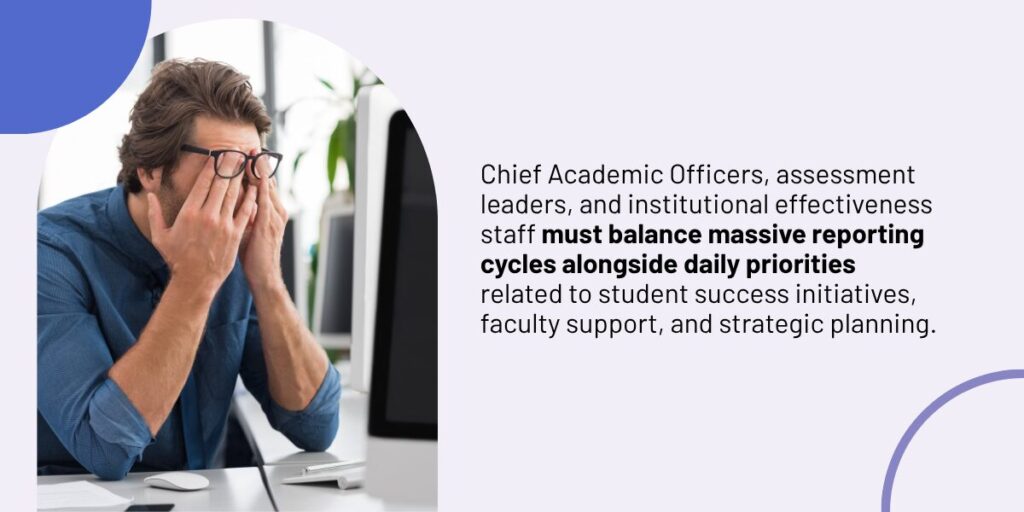
Compounding this data complexity is a distinct resource bottleneck. At many community colleges, accreditation work is managed by exceptionally small teams. Chief Academic Officers (CAOs), assessment leaders, and institutional effectiveness staff must balance these massive reporting cycles alongside daily priorities related to student success initiatives, faculty support, and strategic planning.
In a lean environment, a two-year CAO often spends a disproportionate amount of time manually chasing down paperwork, tracking assessment participation progress, and combating the loss of institutional memory caused by staff turnover. Recognizing these unique constraints early in the self-study workflow is essential to building a reporting process that scales without burning out your team.
Step 4: Prepare for peer review and site visits
After the self-study is submitted, accrediting agencies select a team of peer reviewers to conduct formal evaluations and on-site visits. These reviewers are tasked with verifying that your institution demonstrates academic quality, institutional effectiveness, strategic alignment, and evidence-based improvement practices. For community colleges, reviewers are increasingly looking for explicit, documented proof that your campus actively uses its assessment data to improve programs, support diverse student populations, and align institutional planning with regional workforce needs.
What to organize before reviewers arrive
To eliminate last-minute logistical bottlenecks and instill total confidence in your visiting committee, institutional effectiveness teams should centralize their materials well in advance. Ensure your team has compiled and organized the following essential evidence streams into an accessible, easily navigable format:
- Updated evidence repositories
- Aggregated learning outcomes data
- Comprehensive program reviews
- Student support and retention tracking
- Community and economic alignment
- Cross-department communication frameworks
Step 5: Address recommendations and demonstrate improvement
Following the site visit, accreditors may issue specific recommendations or identify compliance gaps. For resource-lean community colleges, responding to these findings can quickly become a bottleneck if data remains siloed across disconnected teams.
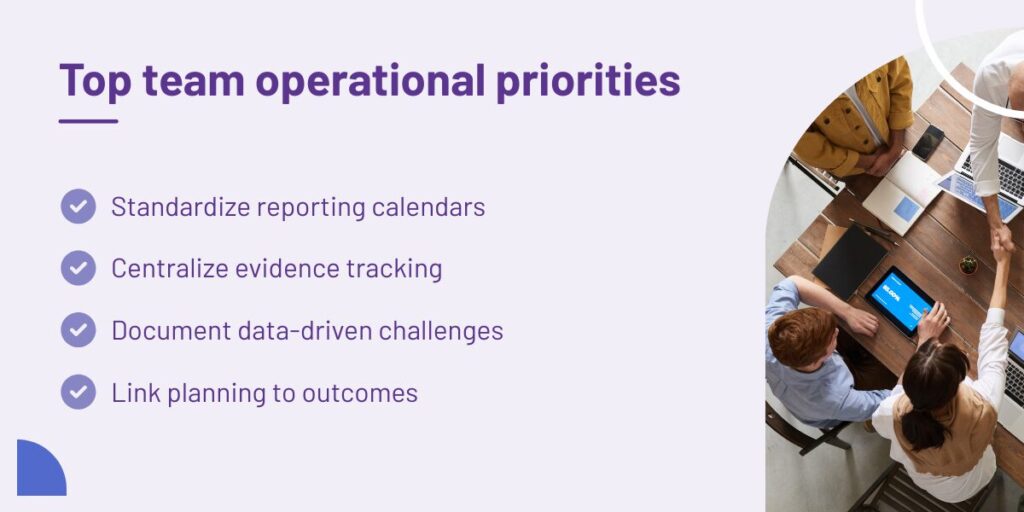
Rather than treating these findings as a one-time administrative crisis, institutions can use this window to permanently centralize documentation and streamline long-term workflows. To satisfy accreditors and maintain sustainable readiness, your team must focus on four operational priorities:
- Standardize reporting calendars: Establish predictable, campus-wide assessment timelines to eliminate sporadic data collection.
- Centralize evidence tracking: Replace scattered email chains with a shared, digital repository to preserve institutional memory against staff turnover.
- Document data-driven changes: Explicitly capture how assessment findings are actively used to improve programs and expand student support.
- Link planning to outcomes: Prove that your long-term strategic goals are directly fueled and measured by daily student learning data.
Accreditation improvement checklist
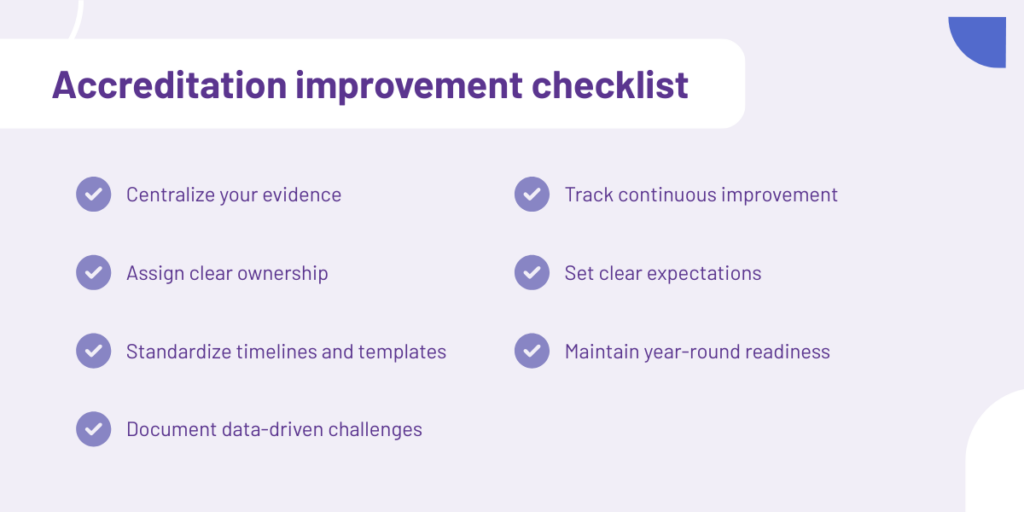
Community colleges can strengthen long-term readiness by following these tips:
- Centralize your evidence: Build a single repository for all accreditation documents, assessment reports, and strategic plans.
- Assign clear ownership: Designate specific leaders across departments to own evidence collection and standards compliance.
- Standardize timelines and templates: Establish an annual assessment calendar with fixed milestones and consistent reporting templates.
- Document data-driven changes: Conduct regular reviews of assessment findings and formally document how they inform program improvements.
- Track continuous improvement: Create dedicated processes to monitor action items and accreditor recommendations between review cycles.
- Set clear expectations: Provide faculty and staff with explicit guidance on documentation requirements and participation.
- Maintain year-round readiness: Review your accreditation benchmarks continuously rather than scrambling right before a site visit
Step 6: Maintain ongoing accreditation readiness
Accreditation is not a one-time process. Institutions must continuously monitor performance, document improvements, and prepare for future reporting cycles and reaffirmation reviews. Many accreditors now expect institutions to demonstrate ongoing improvement between review cycles.
Frequently asked questions about accreditation for schools
How long does the accreditation process for schools take?
The accreditation process for schools can take several months to multiple years depending on the accrediting body, institutional size, reporting requirements, and whether the institution is pursuing initial accreditation or reaffirmation.
Why is accreditation important for community colleges?
Accreditation supports federal financial aid eligibility, transfer credit recognition, academic quality assurance, workforce program credibility, and institutional reputation and accountability.
What is the difference between institutional and programmatic accreditation?
Institutional accreditation evaluates the college or university as a whole, while programmatic accreditation applies to specific programs or disciplines such as nursing, business, or technical education.
What are the biggest accreditation challenges for community colleges?
Common challenges include managing evidence across departments, maintaining continuous assessment participation, coordinating reporting workflows, supporting workforce and transfer pathways simultaneously, and operating with limited staff and resources
How can accreditation software help community colleges?
Accreditation software replaces scattered spreadsheets with a single, centralized system for tracking assessment activities, program reviews, and institutional planning. By continuously compiling this evidence year-round, lean administrative teams save hundreds of hours of manual search time. When it is time for a self-study or peer site visit, your evidence of continuous improvement is already organized, accessible, and ready to demonstrate institutional success to accreditors.
Simplify accreditation management with Watermark
Many community colleges operate with exceptionally lean administrative teams. When a small-college CAO or assessment coordinator spends dozens of hours tracking down missing spreadsheets, institutional effectiveness suffers.
Moving away from disconnected manual systems in favor of integrated technology changes the math entirely. Centralized systems allow institutions to automatically house accreditation evidence, streamline self-study collaborations, and seamlessly track continuous improvement initiatives in one spot.
Watermark’s accreditation readiness solutions, like Planning & Self-Study and Course Evaluations & Surveys, help institutions build sustainable processes for accreditation, assessment, planning, and continuous improvement. By utilizing an ecosystem that connects planning, course evaluations, and faculty activity, your team can stop scrambling to prepare for site visits and focus instead on demonstrating proven success.
See how easy it is to complete each step of the accreditation process with our integrated solutions.