The CV has long been the standard for academic careers, a portable, faculty owned showcase of professional achievement. But in an era of digital instruction, complex student initiatives, and shifting state policies, the traditional CV is no longer sufficient on its own. While it remains a vital list of credentials, it often fails to capture the full scope of a professor’s impact.
Moving “beyond the CV” doesn’t mean throwing it out completely. It means evolving it. It’s about moving from a static, citation-only document toward a dynamic, structured framework that provides context for the work faculty actually do. In practice, this looks like a living record that complements the CV by:
- Replacing lists with evidence
- Capturing the invisible work
- Shifting to real-time visibility.
By complementing the CV with more meaningful ways to represent faculty, institutions can create a more comprehensive way to evaluate different faculty tracks, ensuring that what matters most is finally made visible.
The problem: When the CV no longer tells the whole story
Traditional curriculum development is often slow, manual, and fragmented. Reviews happen on long The traditional CV was designed for a very specific, narrow version of academic life. It’s great for highlighting grants and publications, but for most faculty today, that’s only a fraction of the story.
If you’re a teaching-focused or clinical instructor, your real impact often happens in ways that aren’t easily reflected on a CV. Activities such as mentoring a struggling student, redesigning a curriculum to meet new workforce demands, or leading assessment efforts don’t always translate into a clear list of citations. When we rely solely on the CV, we end up with a massive gap between what faculty actually do and what they’re rewarded for. As institutions rethink faculty evaluation, many are recognizing that the mismatch doesn’t just cause frustration; it makes it nearly impossible for institutions to make fair, evidence-based decisions.
Expanding the evidence: what effective frameworks look like
Rethinking faculty evaluation is a challenge, but successful institutions tend to focus on four strategic shifts:
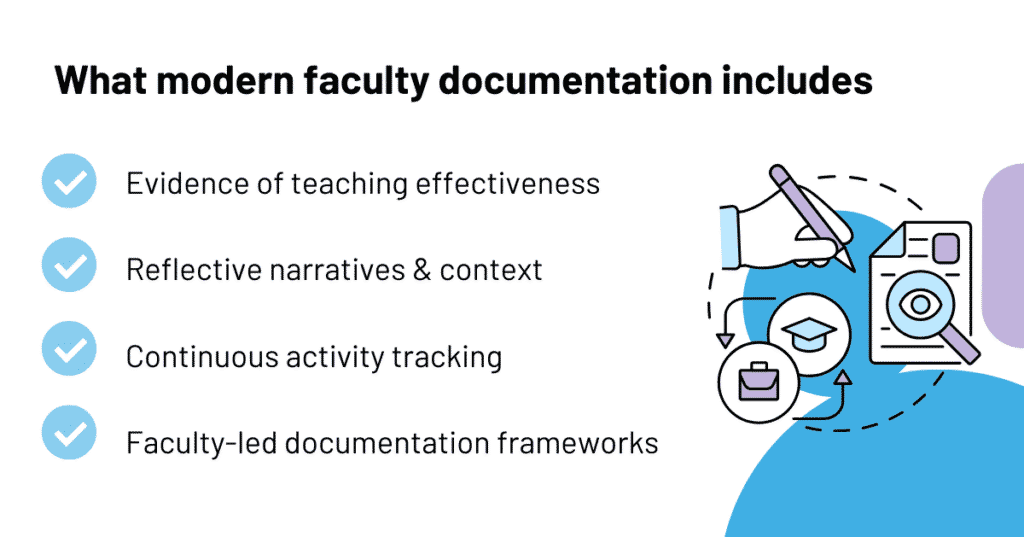
- Evidence over artifacts: Instead of just listing a course on a CV, these frameworks include the full picture: student feedback and reflective narratives that explain how that course met program goals.
- Ongoing habits over annual crises: By tracking activity continuously, faculty don’t have to reconstruct their CV every year. They simply maintain a living record that can be exported into a CV format at any time.
- Faculty-led design: Building frameworks with faculty ensures the system respects disciplinary differences and actually gets used.
- Focus on growth, not just grades: Using documentation as a tool for reflection and shared learning rather than a dead-end compliance check.
Together, these approaches support a more complete and fair evaluation of faculty, grounded in what faculty actually do and why it matters. for its own sake, but better-informed decision-making grounded in data and institutional intent.
Why this shift makes sense now
Higher education is changing quickly, and the way institutions document faculty contributions is changing with it. Expanding faculty responsibilities and new policy expectations are accelerating the move beyond the traditional CV.
The expanding reality of faculty work
The role of faculty in higher education has grown. Professors now navigate multiple instructional formats (online, hybrid, in-person) while balancing shifting enrollment trends and student success initiatives.
Policy pressures and 2026
This isn’t just an internal choice. It’s a response to a changing landscape. State-level changes (starting in Texas and moving through Georgia, Florida, and Ohio) are demanding greater transparency. In the current climate, institutions must be clearer about faculty qualifications and contributions to remain compliant and competitive.
This expansion reflects the evolving nature of institutions, particularly as they respond to enrollment pressures, workforce alignment expectations, and student success initiatives. Faculty are increasingly asked not only to deliver instruction, but to demonstrate its effectiveness, adapt it based on evidence, and connect it to broader institutional outcomes.
Why the traditional CV falls short
The CV isn’t necessarily “broken,” it’s simply focused on a specific set of outcomes. It was designed to highlight high-level milestones like degrees, grants, and publications. However, when institutions use it as the only yardstick for evaluating faculty, they miss the day-to-day realities of those roles.
The CV provides the outline, but it often:
- Prioritizes final outputs over the ongoing process of impact.
- Lacks the structure to show teaching quality or student mentorship.
- Fails to connect individual work to broader accreditation or improvement cycles.
Most importantly, it offers limited support for documenting teaching effectiveness in ways that are evidence-based, transparent, and comparable across roles.
When evaluation relies too heavily on the CV, faculty work that is central to student success and institutional improvement can become invisible or undervalued.
Standardization without uniformity: a necessary reframe
While standardization often triggers fears of rigid checkboxes and punitive one-size-fits-all molds, its true purpose is to provide a consistent, protective structure. By establishing shared expectations for how work is documented, without dictating what that work must be, institutions can replace ambiguity with transparency. This shift ensures faculty reviews are based on explicit, fair criteria rather than departmental guesswork.
This reframe supports faculty evaluation that is:
- Transparent without being rigid
- Comparable without being reductive
- Structured without erasing disciplinary or role-based differences
Standardization, done well, protects faculty by making expectations explicit and reducing ambiguity in how work is reviewed and valued.
Why this matters to faculty – not just institutions
At first glance, the push for more transparency and better documentation feels like just another compliance hurdle. And for many faculty, they can feel that way at first. But the move away from a static, citation-only CV toward a more dynamic record of work creates opportunities.
When documentation includes context, examples, and evidence of impact, faculty are better positioned to show the full scope of their contributions, not just what they produced, but why it matters.
Better documentation helps faculty:
- Communicate the momentum and impact behind their research, teaching, and service.
- Capture contributions that don’t always fit neatly into a traditional CV format.
- Build a consistent record over time instead of reconstructing it under deadline pressure.
- Present evidence that supports promotion, review, and accreditation processes.
Modern faculty activity reporting systems go beyond the traditional CV. Instead of a static list of citations, faculty build a dynamic, context-rich record of their work, one that captures evidence of impact, student outcomes, leadership, and scholarly contribution. It’s not just a report. It’s a living profile that reflects growth and momentum over time. Instead of rebuilding your record from scratch each review cycle, you can focus your energy on the research, teaching, service, and leadership that matter most to your work.
Institutional payoffs: better decisions, better outcomes
For leadership, moving beyond the traditional CV is about visibility. While the CV documents a career, it doesn’t provide a real-time, structured view of faculty activity across the institution. Without that visibility, decisions about workloads, recognition, and resources rely on partial or delayed information.
Modern reporting changes that. By capturing wins as they happen, faculty keep their own records ready for advancement, while leaders finally get a real-time look at what’s actually happening in research and teaching across the institution. Instead of digging through mismatched PDFs, they can quickly spot trends, recognize emerging talent, and see where faculty and the units they’re part of are growing or excelling, and where a little more support could make a big difference. The result is smarter decisions and a clearer picture of how people and departments are progressing over time.
This clarity strengthens institutional effectiveness by:
- Improving alignment between faculty work and student outcomes.
- Supporting accreditation and regulatory reporting with reliable evidence.
- Informing professional development and resource allocation decisions.
- Reducing risk associated with inconsistent or incomplete documentation.
In a time when budgets are tight and public scrutiny is high, we need systems that actually drive institutional improvement, rather than just keeping us “compliant.”
Documenting what matters, valuing who the faculty are
The CV will always be a cornerstone of the academic profession. It is a portable record of a career. But it’s time to stop asking it to do a job it wasn’t built for. Moving beyond the CV is about making the invisible work (late-night mentoring and the heavy lifting of assessment) visible and verifiable.
By embracing frameworks that layer context onto the traditional CV, institutions can better support their faculty and meet current policy expectations without losing the personal showcase that faculty have worked so hard to build.
If you’re ready to simplify your documentation and give your faculty credit for their full range of contributions, explore how Watermark’s Faculty Success solutions can help you align those achievements with your institutional mission.