Faculty are the foundation of every institution’s mission, but the systems used to evaluate their work don’t always reflect how complex those roles have become.
With enrollment pressures, tighter budgets, evolving accreditation expectations, and growing reliance on adjunct faculty, many leaders are rethinking their evaluation models for faculty. What worked when roles were more uniform no longer reflects today’s reality.
Designing fair, focused systems for faculty evaluation is a strategic decision that shapes morale, retention, and long-term institutional effectiveness.
Faculty evaluation isn’t one-size-fits-all
For years, many institutions used the same forms and processes for the evaluation of faculty, applying similar expectations across departments and appointment types. But faculty roles have evolved.
Adjuncts may focus almost entirely on teaching, often across multiple institutions. Full-time faculty balance teaching with research, service, mentoring, and leadership. Clinical faculty, lecturers, and professors of practice add further variation. When identical criteria are applied to fundamentally different roles, evaluations can miss the mark.
Effective faculty evaluation starts with alignment between expectations and actual responsibilities. Instead of treating every role the same, define what success looks like for each individual position and measure progress from there.
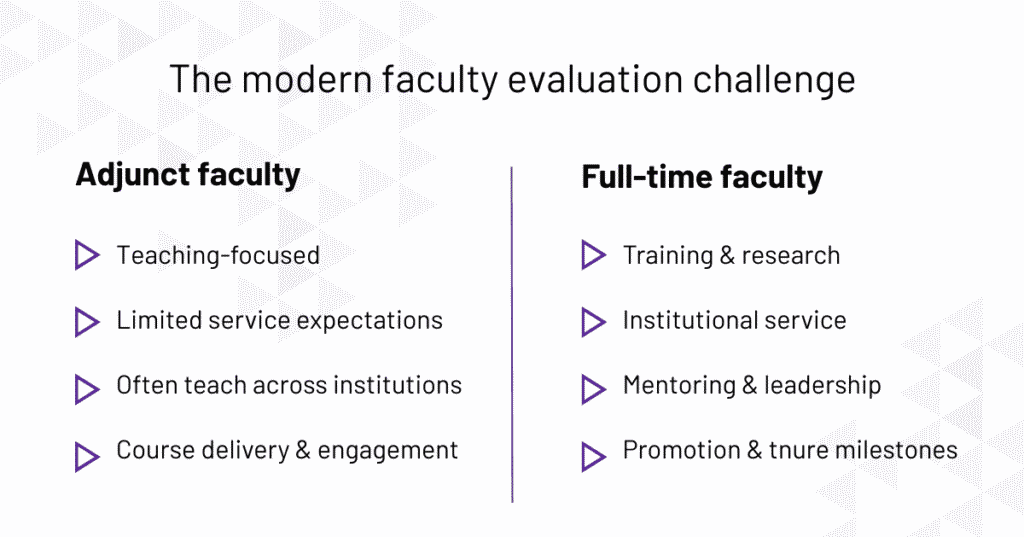
The modern faculty evaluation challenge
Institutions today rely on a mix of full-time, part-time, tenure-track, non-tenure-track, and adjunct faculty. Each group contributes in meaningful but different ways.
Adjunct faculty
Adjunct faculty are often:
- Teaching-focused
- Responsible for high-credit or high-enrollment courses
- Balancing appointments across departments or even multiple institutions
- Less involved in service or research activities
Yet adjunct faculty evaluation processes often mirror those designed for tenure-track roles, placing undue weight on service or scholarship that fall outside an adjunct’s scope.
Stronger adjunct faculty evaluation models focus on what matters most: teaching effectiveness, student engagement, course quality, and alignment with learning outcomes. They provide clear expectations, structured feedback, and opportunities for growth, without adding criteria that don’t apply.
When evaluation reflects actual responsibilities, adjunct faculty are recognized for the contributions they’re hired to make.
Full-time faculty
Full-time faculty typically carry broader portfolios, including:
- Teaching
- Scholarship and research
- Departmental and institutional service
- Mentoring students and junior colleagues
- Leadership roles
- Advancement through promotion and tenure milestones
For these instructors , evaluation models for faculty need to account for career stage, disciplinary standards, and long-term impact.
Promotion and tenure processes add another layer. Documentation must be thorough, transparent, and defensible. Expectations need to be clearly communicated and applied consistently. Without that structure, the evaluation of faculty can quickly become overwhelming for candidates preparing materials and for reviewers trying to assess them fairly. more complete and fair evaluation of faculty, grounded in what faculty actually do and why it matters. for its own sake, but better-informed decision-making grounded in data and institutional intent.
What fair and focused evaluation actually requires
Building meaningful faculty evaluation systems takes more than revising a form or updating a handbook. It requires thoughtful alignment across policy, process, and the tools that support them.
Role-based evaluation frameworks
Strong evaluation models for faculty start with role clarity. Expectations should reflect appointment type and actual responsibilities.
This means:
- Teaching-centered criteria for adjuncts and lecturers
- A balanced mix of teaching, scholarship, and service for tenure-track faculty
- Flexibility to account for disciplinary norms
When evaluation is role-based, expectations are clearer. Faculty understand what they must demonstrate, and reviewers assess work against standards that fit the position. Clear standards build confidence in the process.
Centralized documentation and evidence collection
One of the biggest frustrations in the evaluation of faculty is tracking down documentation. Evidence lives in inboxes, shared drives, PDFs, and disconnected systems. Faculty spend hours compiling materials, and reviewers navigate inconsistent formats.
Centralized systems simplify this process.
When teaching evaluations, peer observations, publications, service records, and supporting materials are housed in one structured system, faculty evaluation becomes more manageable and consistent. Instead of a last-minute scramble, documentation becomes an ongoing record of performance and progress.
Transparent, consistent review workflows
Clear, consistent processes are essential to strong faculty evaluation. Defined workflows help ensure that reviews move through the right stages, that criteria are applied consistently, and that the right people have visibility at the right time.
For leadership, this reduces risk and strengthens defensibility. For faculty, it builds trust.
When evaluation models for faculty are supported by structured workflows, institutions reduce ambiguity and reinforce accountability, especially during high-stakes promotion and tenure cycles.
Data-informed decision-making
Colleges and universities increasingly use data to guide planning and strategy. Faculty evaluation should be part of that picture. When institutions can see trends in teaching effectiveness, workload distribution, advancement patterns, or professional development needs, they are better positioned to respond. Thoughtful use of data can support:
- Review of evaluation consistency
- Resource planning
- Succession strategy
- Faculty development efforts
Data should inform discussion, not replace professional judgment. Well-designed systems provide evidence to support decisions while still allowing room for disciplinary context and nuance.
Supporting adjunct faculty without treating them as an afterthought
Adjunct faculty often teach a large share of courses, yet they haven’t always been fully integrated into institutional systems.
Taking the time to design intentional adjunct faculty evaluation sends a clear message: their work matters. It also helps ensure adjunct instructors receive:
- Clear expectations
- Timely, constructive feedback
- Access to professional development
- A voice in conversations about improvement
When adjunct faculty are supported with structured evaluation processes tailored to their roles, institutions improve teaching quality, student experience, and faculty retention. Evaluation of faculty means recognizing the contributions of all instructors, not only those on tenure-track pathways.tudent success and institutional improvement can become invisible or undervalued.

Supporting full-time faculty through the entire career lifecycle
Full-time faculty need evaluation systems that evolve with them.
Early-career faculty want clear guidance on promotion. Mid-career faculty benefit from structured reflection and goal setting. Senior faculty often shift toward mentoring, leadership, or program development, and these contributions should be recognized.
Strong evaluation models for faculty take this lifecycle into account. They offer:
- Clear promotion and tenure expectations
- Consistent annual review processes
- Alignment between institutional priorities and individual goals
- A way to see professional growth over time
When expectations and processes are transparent, faculty can spend less time navigating the system and more energy focusing on their work and impact. making expectations explicit and reducing ambiguity in how work is reviewed and valued.
Institutional impact: when evaluation systems work
When focused faculty evaluation systems are in place, the benefits extend beyond individual reviews.
Institutions often see:
- Higher faculty engagement
- Stronger preparation for accreditation reviews
- Less administrative scrambling
- More consistent standards across departments
- Greater confidence in promotion and tenure decisions
At a time of increased scrutiny around quality and accountability, stronger evaluation models for faculty signal institutional commitment. Evaluation shifts from a compliance task to a strategic tool, connecting faculty contributions to mission, priorities, and student success.
Designing systems that work for both adjunct and full-time faculty takes intention, but the payoff is significant. Institutions that prioritize clarity, transparency, and role-based expectations are better positioned to attract, support, and retain strong educators.
If your institution is taking a fresh look at its approach to faculty evaluation, it may be time to consider whether your current systems fully support faculty success, from annual reviews to promotion and beyond.
Learn more about how Watermark can help you build a focused, structured approach to evaluation and faculty advancement.