Curriculum development has always been central to academic quality. Today, it’s also under unprecedented pressure. Institutions are expected to keep programs current, aligned with outcomes, responsive to workforce needs, and equitable across modalities, all while working with limited time and resources.
This is where AI curriculum tools are beginning to change the conversation. When applied thoughtfully, AI in curriculum development helps institutions strengthen how they evaluate, prioritize, and improve curriculum over time, grounding decisions in evidence.
Why AI is reshaping curriculum development
Traditional curriculum development is often slow, manual, and fragmented. Reviews happen on long cycles. Data lives in silos. And alignment between courses, outcomes, and assessments can be difficult to see, especially at scale.
Utilizing AI for curriculum development addresses these challenges by helping institutions:
- Analyze large volumes of learning and assessment data
- Identify gaps or misalignment across programs
- Accelerate drafting and revision processes
- Support consistency without limiting academic freedom
Rather than replacing faculty expertise, AI enhances it, giving educators better insight into what’s working, where students are struggling, and where curriculum improvements can have the greatest impact.
The role of AI in modern curriculum design
AI plays a supportive, behind-the-scenes role in curriculum work. Its strength lies in helping institutions interpret evidence, surface patterns, and streamline analysis that would otherwise require significant manual effort.
In modern practice, AI course curriculum tools are most effective when they:
- Work from clearly defined learning outcomes
- Connect curriculum to real evidence of student learning
- Support collaboration across departments and roles
- Integrate with assessment and planning processes
The goal isn’t automation for its own sake, but better-informed decision-making grounded in data and institutional intent.
Key ways AI supports and improves curriculum development
Aligning curriculum with program and institutional outcomes
Alignment is one of the hardest, and most important parts of curriculum design. Using AI in curriculum development can help map course objectives to program-level and institutional outcomes, making alignment easier to see and maintain. This visibility supports coherence, consistency, and stronger assessment narratives.
Using data to understand student performance and identify gaps
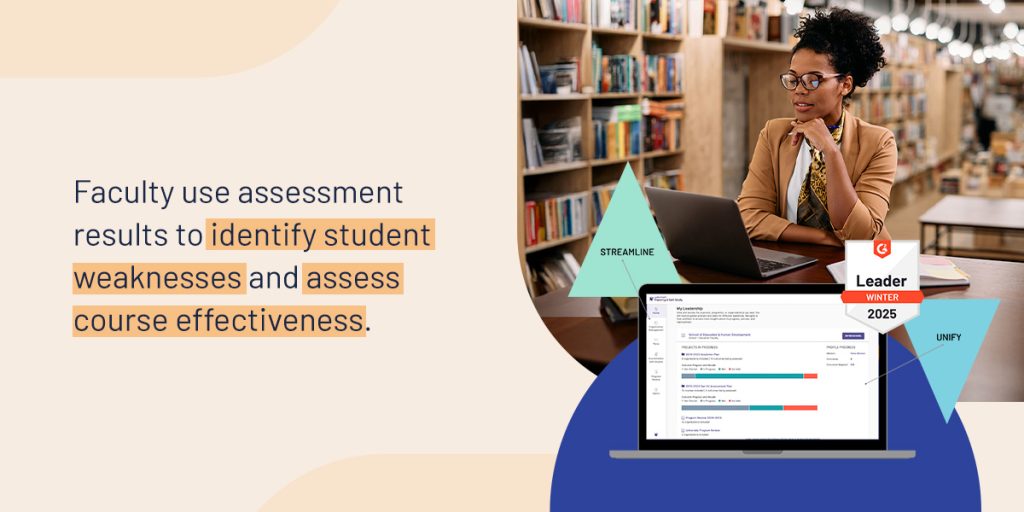
By analyzing trends in assessment results and student performance, AI helps highlight where students are excelling or struggling. These insights allow faculty and leaders to focus curriculum discussions on evidence-based priorities rather than assumptions.
Accelerating content creation and revision
Curriculum development often stalls because drafting takes time. An AI curriculum generator can assist by creating first drafts of course outlines, module structures, or learning objectives that faculty can refine and contextualize. This speeds up iteration without sacrificing quality or ownership.
Strengthening assessments and feedback loops
An effective curriculum depends on meaningful assessment. Using AI for curriculum development can support the development of aligned assessments, rubrics, and feedback mechanisms that reinforce learning outcomes and close the loop between instruction and improvement.
Improving student engagement and learning experiences
By analyzing engagement data and learning patterns, AI can help faculty design a curriculum that better supports active learning, relevance, and clarity. The result is a curriculum that is not only aligned on paper, but engaging in practice.
Supporting continuous course improvement
A curriculum shouldn’t be static. AI curriculum planning tools support continuous improvement by monitoring changes in outcomes, performance, and engagement over time, making it easier to refine courses as needs evolve.
A practical framework for developing curriculum using AI
Step 1: Define your learning outcomes and institutional goals
Start with clarity. AI is most effective when learning outcomes and institutional priorities are clearly defined. Permitting and encouraging the use of AI based on institutional policy and governance will get you heading in the right direction. These guide how AI-generated insights are interpreted and applied.
Step 2: Prepare and centralize your data
For AI to propose curriculum effectively, institutions need organized, connected data, learning outcomes, assessment results, course information, and program structures. Clean data is the foundation for trustworthy insights.
Step 3: Use AI to draft curriculum structures and supporting materials
AI can help generate curriculum frameworks, module sequences, or draft content that faculty can adapt. This accelerates development while preserving academic judgment and context.
Step 4: Audit alignment and curricular coherence
Use AI-supported analysis to review alignment across courses and programs. This step ensures learning outcomes, assessments, and content reinforce one another consistently.
Step 5: Build assessments, rubrics, and learning activities
AI can assist in designing assessments and rubrics aligned to outcomes, strengthening feedback loops, and supporting more consistent evaluation across sections and modalities.
Step 6: Implement, evaluate, and continuously improve
After implementation, AI helps monitor effectiveness by analyzing assessment and engagement data, supporting iterative improvement rather than waiting for the next review cycle.
Challenges and risks of AI-powered curriculum development
To use AI well, institutions should:
- Keep faculty in the decision-making role
- Treat AI outputs as starting points, not final answers
- Be transparent about how AI is used
- Regularly review outcomes and impact
Responsible use builds trust and long-term value.
Turning assessment insight into curriculum action
Effective curriculum improvement starts with clear insight. Colleges and universities gather useful information every year through student feedback, course evaluations, and assessment cycles, but the hard part is turning that evidence into concrete next steps that actually improve learning.
Watermark Planning & Self-Study brings assessment results, outcomes, and improvement plans into a single environment so institutions can move more easily from evidence into action. Within that space, the Assessment Catalyst Toolpack (ACT) adds AI-supported features designed to help institutions see how well they are meeting outcomes today and where to focus improvement efforts next.
With the ACT, institutions can:
- Accelerate analysis: Synthesizes assessment data and drafts summaries
- Reduce busywork: Minimizes the burden of writing narratives from scratch
- Actionable insights: Clarifies next steps for improvement
- Increase engagement: Provides an intuitive process that encourages faculty participation
- Leverage historical context: Draw on historical context from prior assessment cycles
The ACT doesn’t replace faculty judgment; it’s built to support it. The goal is to help teams interpret assessment evidence more efficiently so they can move from insight to improvement planning with greater confidence. As institutions sharpen how they use student feedback and assessment data, those insights become a practical driver of curriculum change. Course and program updates become more intentional, evidence-based, and aligned with institutional goals.
When assessment insights are clear and actionable, curriculum improvement feels like a natural next step, not an added burden.
Accelerate analysis and turn assessment findings into tangible action. See how the Assessment Catalyst Toolpack for Watermark Planning & Self-Study can support you now.