Higher education is hitting a massive inflection point in 2026. Between shifting demographics, aggressive state-level legislation, and the rapid rise of AI, institutional leaders are navigating significant changes. The wait-and-see approach is officially over.
Across the country, higher education policy news is signaling a move away from loosely defined autonomy toward clearer accountability, public visibility, and measurable outcomes. One of the clearest signals of this shift is the expanding requirement that public institutions make course syllabi publicly accessible.
What began in Texas has now spread to Florida, Georgia, Indiana, Ohio, and North Carolina. Six states (and counting) are now requiring public colleges and universities to post syllabi online. What we’re seeing here isn’t an isolated case. It’s a clear signal that the national higher education landscape is moving toward a more transparent model.
This guide breaks down higher education trends shaping 2026 and what you need to know to prepare for the years ahead.
Why 2026 is a turning point for higher education
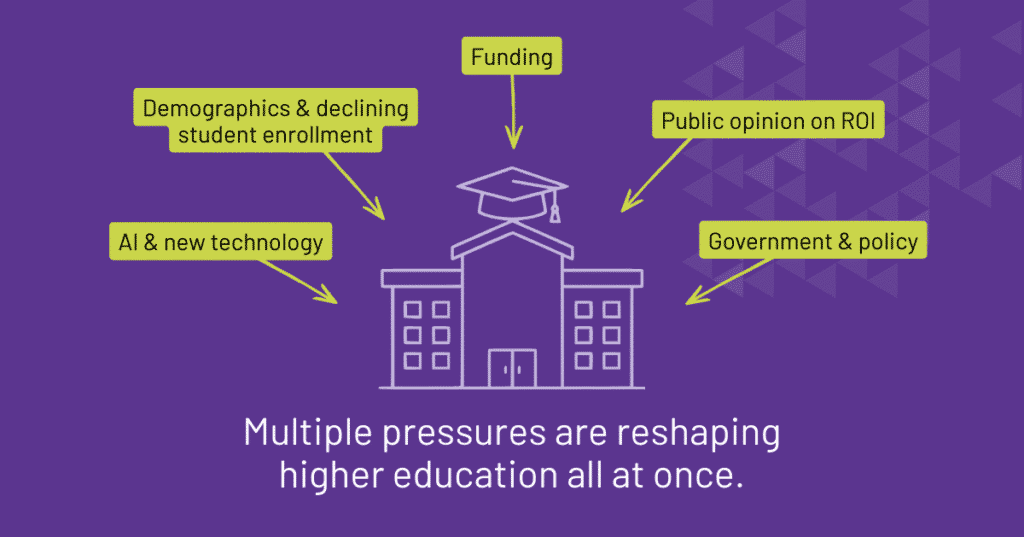
The challenges hitting higher ed right now aren’t necessarily new, but the fact that they’re all hitting at once is. We’re facing a demographic cliff, tighter budgets, and political pressure simultaneously, which effectively eliminates the luxury of a slow transition. The timeline for adapting has been cut in half.
Unlike previous cycles, this moment is being driven as much by public policy as by market forces. Lawmakers and governing boards are increasingly focused on transparency, workforce relevance, and return on investment. This is an important shift in higher education outcomes that forces institutions to rethink how they’re telling their institutional stories
Recent actions from the Florida Board of Governors, including requirements that public institutions post detailed syllabi and reading lists online, illustrate how quickly expectations around instructional transparency are escalating. These policies are not symbolic. They require operational infrastructure, coordination, and oversight.
Institutions that proactively adapt to changes in higher ed data are better positioned to respond with clarity and readiness to lead with evidence if you want to stay ahead of the curve.
Enrollment realities and the onset of the enrollment cliff
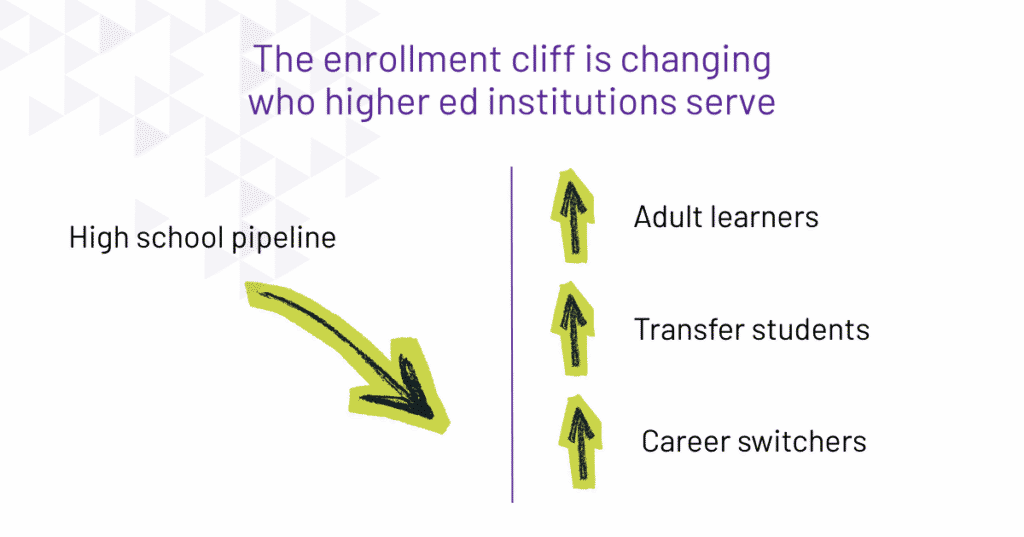
The enrollment cliff is no longer a future problem; it’s here. The demographic shift is hitting campuses hard, and it’s creating a hyper-competitive environment that many institutions aren’t prepared for.
Current higher education enrollment trends point to:
- Heightened competition for a much smaller pool of high school grads.
- A pivot toward adult learners and transfer students who need different types of support.
- A deliberate focus on “value.” Students are more sensitive than ever to how much time and money they’re spending.
Institutions that once depended on a steady stream of freshmen are being forced to rethink recruitment strategies, program portfolios, and student support models. Many are actively working to navigate the enrollment cliff in higher education by expanding adult pathways, strengthening retention strategies, and using predictive analytics to improve student enrollment.
These shifts are also influencing higher education marketing trends, as institutions emphasize outcomes, flexibility, and career relevance over traditional prestige narratives.
In a climate defined by growth trends in the higher education industry, visibility and credibility increasingly shape enrollment decisions.
Generative AI in higher ed: from disruption to governance
Generative AI has moved from novelty to necessity in less than two years. We’ve stopped panic-talking about cheating in the classroom and started focusing on the much bigger picture: governance. By 2026, the real work will shift to how we manage these tools at the institutional level.
Leaders are now asking:
- Where is the actual ROI? How do we use AI to add value without compromising our academic standards?
- What does the guardrail look like? How do we set a policy that is flexible but safe?
- Can it actually help us with the heavy lifting? Specifically in assessment, reporting, and planning.
These questions are central to technology trends in higher education. Institutions are increasingly prioritizing ethical AI for higher ed success, ensuring AI adoption is transparent, responsible, and aligned with mission-critical outcomes. In practice, AI is already supporting assessment, helping institutions surface insights from large datasets and strengthen continuous improvement processes. Some are also exploring how to responsibly develop curriculum using AI, ensuring that innovation enhances (rather than replaces) academic rigor and faculty expertise.
Institutions that establish clear AI policies, align use cases with mission, and invest in governance frameworks will be better positioned to harness AI as a strategic asset rather than a reputational risk.
Accreditation in flux: rising expectations for outcomes and accountability
Accreditation is evolving as policymakers, institutions, and the public place greater emphasis on demonstrating student outcomes, institutional value, and long-term return on investment. While accreditation has always focused on quality assurance, current conversations increasingly center on how institutions document student learning, program effectiveness, and post-graduation success.
These expectations are prompting institutions to strengthen the systems and processes they use to collect, evaluate, and act on evidence of student learning and institutional performance.To respond effectively, institutions must ensure that:
- Learning outcomes are clearly defined and consistently assessed.
- Program review processes are connected to institutional planning and improvement.
- Evidence of student learning informs both accreditation reporting and internal decision-making.
- Quality assurance processes extend beyond compliance to support continuous improvement.
Institutions that succeed in this environment move beyond episodic accreditation preparation and build sustainable systems for documenting and improving student outcomes.
The gradual rise of alternative credentials and skills-based learning
Alongside these accreditation conversations, alternative credentials, such as certificates, digital badges, and microcredentials, are gaining attention in certain sectors of higher education. While adoption varies widely across institutions, these credentials often reflect growing interest from employers and policymakers in skills-based learning and workforce alignment.
When institutions pursue alternative credentials, maintaining academic quality is essential.
Effective programs typically ensure that credentials are:
- Aligned with clearly defined learning outcomes.
- Assessed with appropriate academic rigor.
- Connected to workforce-relevant skills where appropriate.
- Integrated into the institution’s broader quality assurance and assessment frameworks.
When thoughtfully implemented, alternative credentials can complement traditional degrees while still operating within the same culture of evidence and institutional effectiveness.
Changing learner expectations: flexibility, value, and outcomes
Learner expectations in higher education are evolving. While students continue to pursue college for many reasons, such as intellectual growth, community, and long-term opportunity, questions about cost, career pathways, and practical outcomes are playing a more prominent role in enrollment decisions than in the past.
Rising tuition costs, economic uncertainty, and shifting workforce demands have led many students and families to think more carefully about how educational experiences translate into long-term opportunity. As a result, prospective learners are increasingly considering questions such as:
- The Content: What knowledge and skills will this program help me develop?
- The Timeline: How does this program fit into my life and career plans?
- The Outcomes: What opportunities might it open after graduation?
These considerations are influencing how institutions design and deliver academic programs. Flexible learning modalities, clearer program pathways, and stronger connections between learning outcomes and career preparation are becoming more common across the sector.
Institutions that respond thoughtfully to these changing expectations, while still preserving the broader educational mission of higher education, are better positioned to navigate long-term higher education industry growth trends. Those that fail to adapt risk falling behind in an increasingly competitive and value-conscious enrollment environment.

Transparency, accountability, and evolving compliance expectations
The growing list of states requiring public syllabi – Texas, Florida, Georgia, Indiana, Ohio, and North Carolina – reflects a broader shift toward greater transparency in higher education. These policies require public institutions to make course syllabi accessible online, often including information about course content, learning outcomes, and instructional materials.
While these mandates are primarily compliance-driven, they also expand public visibility into how institutions design and deliver instruction. For many campuses, the challenge is less about publishing syllabi and more about managing them consistently across departments, formats, and academic terms.
Several states have already implemented specific requirements. Florida’s Board of Governors requires institutions to publish detailed syllabi and reading lists online. Texas institutions have expanded documentation practices as syllabi and faculty materials become more publicly accessible. Georgia, Indiana, Ohio, and North Carolina have introduced similar policies requiring syllabi to be posted online.
Together, these developments signal a shift toward ongoing transparency around instructional practices and outcomes. In some states, syllabus requirements also intersect with broader expectations around faculty credentials and public profiles, reinforcing the importance of clearly documenting both course content and instructional expertise.
From an operational perspective, maintaining accurate, up-to-date syllabi across departments and modalities requires coordinated workflows and oversight. Posting syllabi at scale typically involves:
- Version control across course iterations
- Cross-campus coordination between departments and faculty
- Consistent formatting and documentation standards
- Regular updates as courses evolve
- Alignment with learning outcomes and assessment practices
Many institutions rely on specialized syllabus management platforms, such as Concourse Syllabus, a Watermark partner, to support the creation and maintenance of syllabi. These systems help faculty develop and update course materials while maintaining consistency and accessibility.
At the same time, syllabus transparency often intersects with other institutional systems. Faculty activity and profile platforms may host or publish syllabi alongside faculty credentials and scholarly work, particularly in states where both course materials and faculty information must be publicly accessible.
For institutional leaders, these evolving requirements highlight the importance of sustainable infrastructure that supports transparency without adding unnecessary administrative burden. As accountability expectations continue to grow, institutions will increasingly need connected systems that support documentation, visibility, and evidence across teaching, faculty activity, and institutional reporting.
Financial and funding pressures reshaping institutional strategy
The financial landscape for higher ed is becoming increasingly complex. Faced with escalating operational costs and fluctuating public funding, institutional leaders are increasingly forced to navigate difficult trade-offs that leave little room for ideal outcomes.
Pew Charitable Trusts analysis suggests that fiscal uncertainty facing higher education is likely to persist well beyond the near term, as state budget pressures, shifting federal funding, and enrollment changes continue to strain institutional finances. As a result, institutions are prioritizing:
- Cost containment and operational efficiency
- Predictable, scalable investments
- Demonstrated value tied to mission and outcomes
Succeeding in this climate requires moving past guesswork. Leaders must use data-driven planning to turn these financial hurdles into a roadmap for long-term stability.
The post-affirmative action landscape
The legal environment surrounding affirmative action and diversity initiatives continues to evolve, creating new considerations for institutional leaders. Recent court decisions and policy changes have prompted colleges and universities to review how they approach admissions, hiring practices, and program design.
In this environment, clear documentation of policies, processes, and decision-making has become increasingly important. Institutions must be able to demonstrate that their practices align with both their mission and current legal frameworks.
For many leaders, this shift reinforces the importance of transparency, consistent governance processes, and reliable data when evaluating institutional policies and outcomes. In a landscape defined by legal scrutiny and public attention, clarity and documentation help institutions navigate complexity with confidence.
Navigating transition with intention and insight
Taken together, these developments signal a period of meaningful transition for higher education. Financial pressures, evolving accreditation expectations, shifting learner priorities, growing transparency requirements, and changes in the legal landscape are all reshaping how institutions operate and demonstrate their value.
For institutional leaders, the challenge is not simply responding to each shift in isolation. It is building the strategy, systems, and culture needed to navigate complexity in a sustainable way. That means aligning planning, assessment, and institutional effectiveness efforts so decisions are guided by evidence rather than assumptions.
Periods of disruption often define the institutions that lead the next era of higher education. Those that use this moment to strengthen their culture of evidence, connect strategy to outcomes, and make intentional, data-informed decisions will be best positioned to adapt, demonstrate impact, and advance their mission in the years ahead.
Empower your team and simplify the complex. Learn more about Watermark’s Planning and Self-Study now.