Higher education is operating under mounting pressure. Institutions are expected to deliver strong student outcomes, align programs to workforce needs, meet evolving accreditation requirements, and remain financially sustainable, all with constrained budgets, lean teams, and heightened accountability. In this reality, higher education technology is no longer optional. It is a foundational infrastructure for fulfilling commitments to students and protecting the institution itself.
When implemented with purpose, technology in higher education helps institutions move beyond fragmented processes toward connected, evidence-based decision-making. Increasingly, AI in higher education is accelerating that shift, enabling colleges and universities to turn data into insight and insight into action at scale.
Why technology is essential for institutional improvement today
Institutional improvement depends on visibility, alignment, and the ability to act on evidence. Yet many colleges still rely on disconnected systems, manual reporting, and siloed workflows that make it slow and time-consuming to see the full picture of student learning and institutional performance.
Technology and higher education are now inseparable. Leaders need systems that not only collect data but connect it across assessment, curriculum, planning, accreditation, faculty activity, and student success initiatives. As expectations for accountability rise, higher education technology solutions play an important role in helping institutions demonstrate effectiveness while continuously improving outcomes.The emergence of AI and higher education further raises the stakes. AI-powered tools can reduce administrative burden, surface patterns faster, and support more proactive, informed leadership, but only when paired with strong data foundations and human oversight.
Enhancing student learning and academic outcomes
At its core, institutional improvement is about student success. The right technology for higher education strengthens learning experiences while supporting instructional quality and consistency.
Personalized and adaptive tools
Digital platforms increasingly allow institutions to tailor learning experiences based on student needs, progress, and engagement. Adaptive tools help faculty identify where students are struggling and adjust instruction accordingly, supporting persistence and equitable outcomes. When paired with assessment data, these tools provide clearer insight into what students know and can do.
Flexible hybrid and online learning environments
Hybrid and online learning are now permanent features of higher education. Technology enables institutions to deliver high-quality instruction across modalities while maintaining alignment with learning outcomes. Consistent digital environments support access, flexibility, and continuity, especially for working adults and nontraditional learners.
Digital collaboration and feedback tools
Modern campus technology ecosystems improve communication between students and faculty, making feedback more timely and actionable. Shared digital spaces also support collaboration among faculty, helping departments align curriculum, assessment, and instructional practices across sections and programs.
Driving operational efficiency through smarter systems
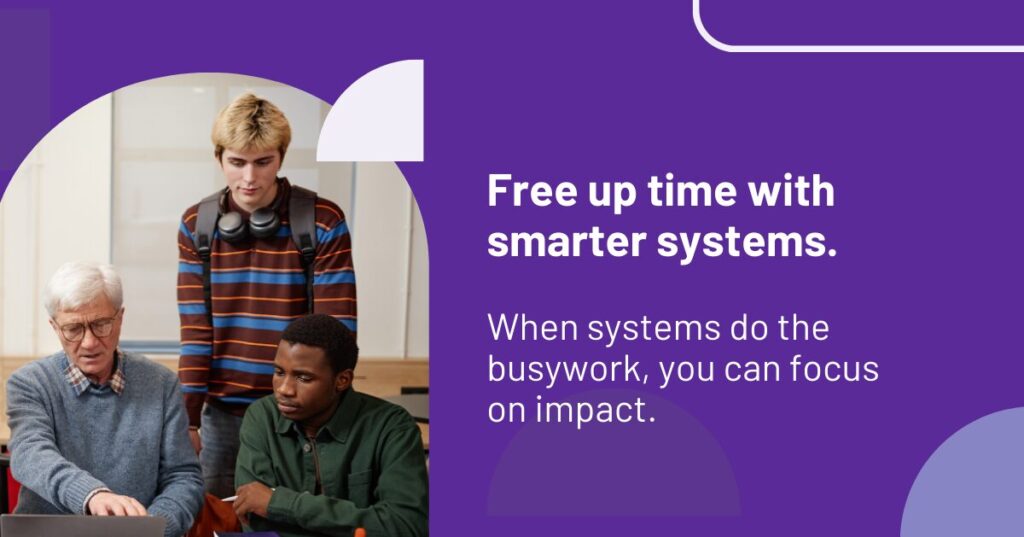
Improvement cannot scale when faculty and staff are overwhelmed by cumbersome tasks and workflows. Strategic higher education technology reduces friction and frees time for higher-value activities.
Automation that eliminates manual, repetitive tasks
Automation is one of the most immediate benefits of modern systems. From assessment reporting to accreditation documentation, automation reduces duplication, minimizes errors, and shortens turnaround times. This allows institutional leaders to shift focus from managing tasks and regurgitating information to evaluating impact.
Centralized data and system integration
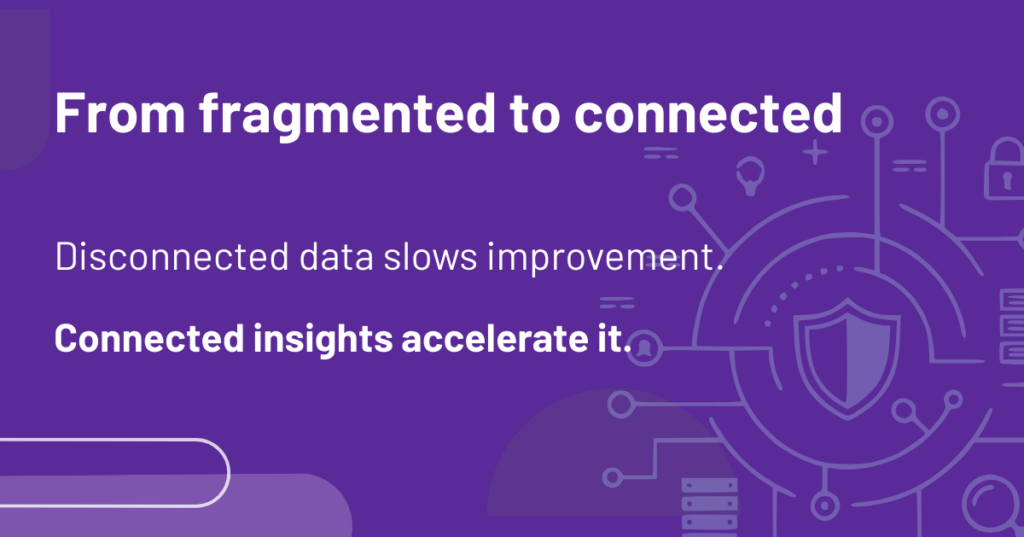
Disconnected systems limit insight. Centralized platforms that integrate data across academic and administrative functions provide a more complete view of institutional performance. This alignment is essential for effective planning, assessment, and demonstrating value.
Cloud accessibility and scalability
Cloud-based solutions support collaboration across campuses, roles, and locations. They also scale as institutional needs evolve, ensuring technology remains an enabler, not a constraint, as enrollment, programs, and reporting demands change.
Built for scale, sustainability, and collaboration
Instead of sinking resources into building and maintaining home-grown systems, institutions can pivot to specialized, vendor-supported platforms that deliver immediate value. These solutions are engineered for the unique complexities of higher education, facilitating seamless collaboration across campuses without the overhead of continuous re-engineering.
By partnering with a dedicated provider, institutions shift from being “system builders” to “system users” and gain access to a team singularly focused on solving the challenges colleges and universities face every day. Because these partners work alongside a wide range of institutions with similar needs, they can innovate quickly, anticipate emerging requirements, and apply proven solutions at scale. The result is technology that evolves with shifting enrollment patterns and reporting demands, backed by expertise and continuous improvement, rather than becoming an internal burden.
Using data analytics to guide strategic decisions
Data is only valuable when it informs decisions. Advanced analytics tools help leaders interpret trends in student learning, engagement, and outcomes over time. Dashboards and visualizations make it easier to identify gaps, monitor progress, and evaluate the effectiveness of initiatives.
As AI for higher education matures, predictive analytics, pattern recognition, and data-derived recommendations can further support proactive decision-making. These capabilities help institutions move from reactive reporting to forward-looking strategy grounded in evidence.
Key capabilities institutions should prioritize when selecting technology
Based on Watermark research and feedback from institutional leaders, several capabilities consistently differentiate technology that drives improvement from technology that simply digitizes processes:
- Automation that reduces administrative burden and improves consistency
- Centralization that connects evidence across assessment, planning, and accreditation
- Scalability that grows with institutional complexity and evolving priorities, supporting long-term sustainability rather than short-term fixes
- Collaboration that connects roles and departments from day one, without the burden of building or maintaining a custom internal infrastructure.
- Responsible, assisting AI streamlines time-intensive tasks like narrative drafting with optional AI capabilities built for transparency and faculty oversight, never replacing human expertise.
Together, these capabilities enable institutions to sustain improvement efforts without increasing workload or compromising trust.
Implementing technology effectively: strategies for higher education leaders
Successful implementation is as much about leadership as it is about tools. Drawing on insights from Dr. Glenn Phillips, Watermark’s Senior Insights Consultant, the four recommended steps to take while building your strategy are:
- Know the technology you want to implement and how it will support and improve your current processes. Develop a deep understanding of what your new technology will bring to the table and how it fits with your institution’s technology culture (i.e. AI, integrations, shared or siloed platforms) .
- Identify your allies and gather a group of individuals who are on board. Be sure to involve the IT department from the start. This ensures a smooth, accessible rollout with single sign-on (SSO) access and integration with other key software applications (for example, your learning management system). Additionally, make sure that if you adopt any technology that takes advantage of AI, the foundational LLM and AI permissions align with IT and any institutional policies.
- Make yourself accessible to the people who are using the tech. Be available to answer their questions and talk through your goals for the onboarding process. This often means exploring all the bells and whistles of a tool, even if you do not plan on using them yourself.
- Show everyone the benefits of the technology. Ensure your faculty and staff know how the technology can help improve their work lives and processes, and reassure them it won’t become a hindrance. This is particularly important if your new technology has features (AI or integration) that may be new to users.
When leaders frame technology as a partner in improvement, rather than a compliance mechanism, adoption and impact increase significantly.
Building a compelling case for investment
Institutional leaders are making technology decisions in an environment defined by budget pressure, heightened scrutiny, and long-term uncertainty. As a result, the strongest investment cases go beyond feature comparisons and focus on outcomes that matter the most right now:
- Cost Containment: True ROI comes from replacing fragmented, home-grown systems with efficient, purpose-built platforms. This reduces long-term operational costs and eliminates the need for expensive, manual re-engineering.
- Risk Reduction: Modernizing your infrastructure protects the institution from the security and compliance vulnerabilities inherent in legacy systems. A secure, vendor-supported environment ensures data integrity and reduces institutional liability.
- Predictability and Future-Proofing: By choosing a partner dedicated to continuous improvement, institutions gain a predictable technology roadmap. This ensures your systems evolve alongside changing accreditation standards and reporting needs without unexpected “fork-in-the-road” expenses.
- Demonstrated Value: The ultimate goal is measurable impact. Value is shown through clearer insight, stronger alignment between strategy and evidence, and measurable improvements in learning and institutional effectiveness.
When higher education technology solutions are positioned as core infrastructure, not a point solution, investment decisions become easier to defend. Leaders can connect spending directly to institutional health, mission alignment, and the ability to operate with confidence in a changing environment.
Expert insights: Lessons from Dr. Glenn Phillips
Dr. Phillips emphasizes that technology alone does not drive improvement; people do. The role of technology is to support clarity, consistency, and collaboration. Institutions that succeed are those that pair strong leadership with systems designed to make evidence visible, actionable, and meaningful across the organization.
Institutional improvement requires more than good intentions. It requires connected evidence, informed decisions, and the ability to act at scale. In today’s environment, technology and higher education are inseparable, and AI in higher education is accelerating what’s possible.
When institutions invest in thoughtful, integrated technology for higher education, they move beyond managing processes to driving progress. The result is stronger student outcomes, more confident decision-making, and a culture of continuous improvement that can adapt to whatever comes next.
Learn how Watermark can help support you by requesting a demo.
What could your faculty achieve with more time for students and less time on data entry? Discover how Watermark’s ethical AI tools, from Instructor Insights to automated data entry, can streamline your workflows without compromising integrity.