Curriculum mapping helps colleges and universities align courses to learning outcomes and identify assessment activities that help program and institutional leaders better understand the impact of their classroom activity..
By aligning course program learning outcomes with institutional learning outcomes in curriculum maps and outcome maps faculty, assessment leaders, and academic administrators can better evaluate whether programs support intended knowledge and skill development across the curriculum.
For example, a nursing program may map clinical reasoning outcomes across courses, while a business program may track communication and ethical decision-making competencies. Beyond course alignment, curriculum mapping supports assessment planning, accreditation efforts, curricular coherence, and continuous improvement initiatives.
Why curriculum mapping matters
Curriculum mapping helps institutions evaluate how academic programs align coursework to learning outcomes. By also mapping curriculum to established institutional learning outcomes, colleges and universities can show how classroom experience and program excellence contribute to institutional learning outcomes, mission, and strategic goals .
For assessment and institutional effectiveness leaders, curriculum mapping supports assessment planning, accreditation reporting, program review, and continuous improvement efforts. Faculty and program coordinators can use curriculum maps to better understand how courses contribute to program outcomes and whether students are building competencies progressively throughout the curriculum. Academic affairs leaders and deans can use curriculum mapping to evaluate program effectiveness, curricular coherence, and alignment across departments and disciplines.
Curriculum mapping can also help institutions:
- Identify gaps in learning outcome coverage
- Reduce unnecessary overlap between courses
- Support collaboration across departments
- Align curriculum with accreditation expectations
- Improve assessment planning and evidence collection
- Maintain consistency during curriculum revisions
- Strengthen continuous improvement efforts
As institutions manage increasingly complex academic operations, curriculum mapping can also provide more centralized visibility into how programs evolve over time and how curricular decisions support student success initiatives.
How to implement curriculum mapping
Effective curriculum mapping is typically a collaborative process involving faculty, program leaders, assessment professionals, and academic administrators. While implementation approaches vary by institution, most curriculum mapping initiatives include several foundational steps.
Define program and learning outcomes
Institutions first identify the outcomes students are expected to achieve within a program or course sequence. These may include program learning outcomes, institutional learning outcomes, accreditation competencies for programs with a discipline-specific accreditor, or workforce-related skills.
Align courses and learning experiences
Courses, assignments, and cocurricular experiences are then aligned to those outcomes to determine where students develop specific knowledge and skills throughout the curriculum.
Identify outcome progression
Many institutions use progression levels such as Introduced, Reinforced, Assessed, and Mastered to show the degree to which students are expected to meet an outcome. This helps faculty and assessment leaders evaluate whether learning experiences are scaffolded appropriately across a program.
Review assessment alignment
Institutions can then evaluate whether assessment activities meaningfully measure intended outcomes and whether sufficient evidence exists to support assessment and accreditation efforts.
Evaluate gaps and opportunities
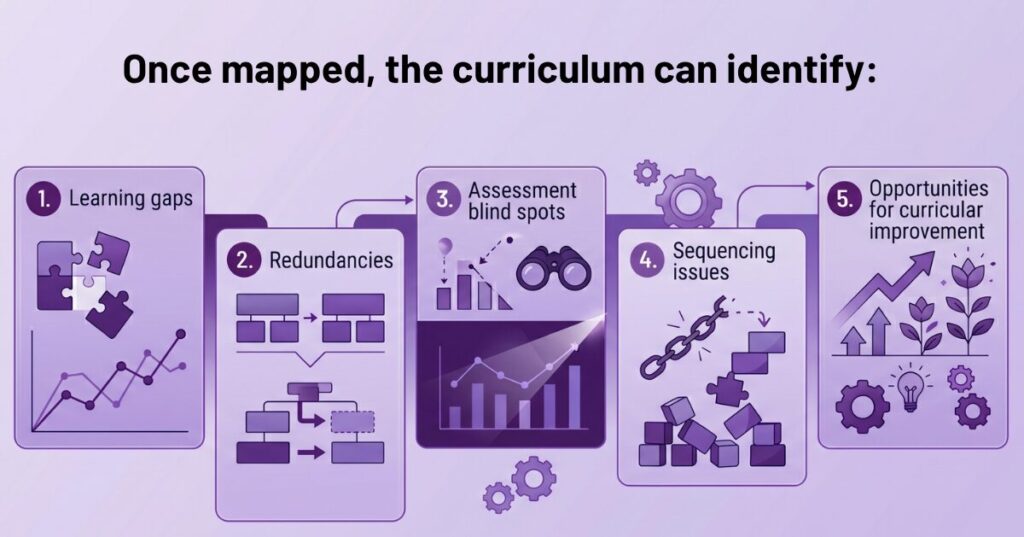
Once mapped, the curriculum can be reviewed collaboratively to identify:
- learning gaps
- redundancies
- assessment blind spots
- sequencing issues
- or opportunities for curricular improvement
This process is not intended to be static. Curriculum mapping is most effective when treated as an ongoing continuous improvement practice that evolves alongside changes in a discipline, pedagogical shifts, institutional priorities, accreditation expectations, industry needs, and student learning goals.
Common curriculum mapping challenges
While curriculum mapping can provide valuable institutional insight, maintaining effective curriculum maps across departments and review cycles can be difficult without consistent processes and centralized visibility.
Common challenges include:
- Managing curriculum maps across multiple programs and departments
- Maintaining version control and consistency over time
- Aligning assessment activities to learning outcomes
- Coordinating collaboration among faculty and administrators
- Tracking curricular changes and revisions
- Connecting curriculum mapping to assessment planning workflows
- Managing data manually through spreadsheets or disconnected systems
Institutions may also struggle to maintain alignment between curriculum maps, assessment results, accreditation reporting, and program review processes when information lives across multiple systems or teams.
Curriculum mapping use cases
Institutions use curriculum mapping in a variety of ways to support academic quality, assessment practices, and institutional effectiveness initiatives.
Assessment planning
Curriculum mapping helps assessment leaders identify where learning outcomes are taught and assessed, making it easier to coordinate assessment activities and collect evidence for continuous improvement efforts.
Accreditation support
Institutions can use curriculum maps to demonstrate alignment between courses, outcomes, and assessment processes during accreditation reviews and self-study activities.
Curriculum review and revision
Faculty and program leaders often use curriculum maps to evaluate curricular coherence and determine whether program changes are needed to improve outcome achievement or respond to evolving workforce expectations.
Workforce and industry alignment
Trade schools, career-focused institutions, and workforce-oriented programs may use curriculum mapping to align curriculum with certification requirements, industry expectations, and workforce readiness goals.
Student learning outcomes improvement
Curriculum mapping helps institutions better understand whether students have sufficient opportunities to develop and demonstrate targeted competencies throughout a program.
How technology supports curriculum mapping
As curriculum mapping initiatives expand across programs and departments, many institutions seek more centralized ways to manage alignment, assessment, and curriculum review workflows. Technology can support more consistent curriculum mapping practices by providing visibility into learning outcomes, course alignment, assessment activities, and program changes.
Watermark Planning & Self-Study supports curriculum mapping, assessment planning, accreditation activities, and continuous improvement workflows by helping institutions connect outcomes, courses, and assessment evidence in one place.
Institutions can also use curriculum mapping insights to inform broader curriculum review and governance processes. In some cases, curricular changes identified through mapping and assessment activities may be managed through Watermark Curriculum Strategy to support curriculum proposal and approval workflows.
Frequently asked questions
What is curriculum mapping in higher education?
Curriculum mapping is the process of aligning courses and learning outcomes to evaluate how a curriculum supports student learning and institutional objectives.
Who uses curriculum maps?
Curriculum maps are commonly used by assessment leaders, faculty, program coordinators, academic deans, and academic affairs leaders to support assessment planning, program review, accreditation, and continuous improvement efforts.
How does curriculum mapping support student outcomes?
Curriculum mapping helps institutions evaluate whether students have structured opportunities to develop and demonstrate intended competencies throughout a program. This can support more coherent curriculum design and stronger alignment between learning experiences and outcomes.
What are common curriculum mapping challenges?
Common challenges include maintaining alignment across departments, tracking curricular changes, coordinating faculty collaboration, managing assessment data, and keeping curriculum maps updated over time.
How often should curriculum maps be reviewed?
Many institutions review curriculum maps during assessment cycles, program review processes, accreditation preparation, or whenever significant curricular changes occur. Ongoing review helps institutions maintain alignment and support continuous improvement efforts.
Support curriculum alignment and assessment planning
Curriculum mapping helps institutions better understand how courses, outcomes, and assessment activities work together to support student learning and program effectiveness. When combined with ongoing assessment and continuous improvement practices, mapping provides the structural insights needed to maintain curricular coherence and align daily coursework with institutional learning outcomes.
See how Watermark Planning & Self-Study helps institutions support curriculum mapping, assessment planning, accreditation activities, and continuous improvement workflows across programs and departments.
When assessment data and curriculum maps reveal that updates are required, you can seamlessly transition from insight to action. Discover how Watermark Curriculum Strategy helps you efficiently manage course and program changes through your institutional approval process to keep your curriculum responsive and aligned.
Request your live demo to see how curriculum maps in Watermark connect intent to results to reveal program strengths and gaps you can act on.