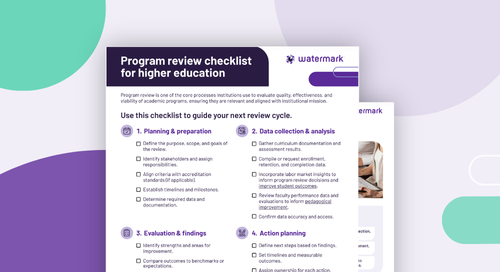
Program review is one of the core processes institutions use to evaluate academic quality, support student outcomes, and stay aligned with accreditation expectations.
A structured approach to higher education program review helps connect data, assessment, and institutional priorities, so that findings lead to meaningful action. For institutions preparing for accreditation, having a clear accreditation checklist can make each step more manageable and consistent.
Explore how to streamline your program review and accreditation process with Planning & Self-Study.
What is a program review?
A program review is a structured evaluation of an academic program’s effectiveness. It typically examines student outcomes, curriculum, faculty resources, and alignment with institutional goals.
In higher education program review, this process supports institutions in:
- Meeting accreditation requirements
- Identifying areas for improvement
- Demonstrating effectiveness and accountability
Many institutions use a self-study checklist for higher education accreditation to guide this work, helping ensure consistency and alignment with accreditor expectations.
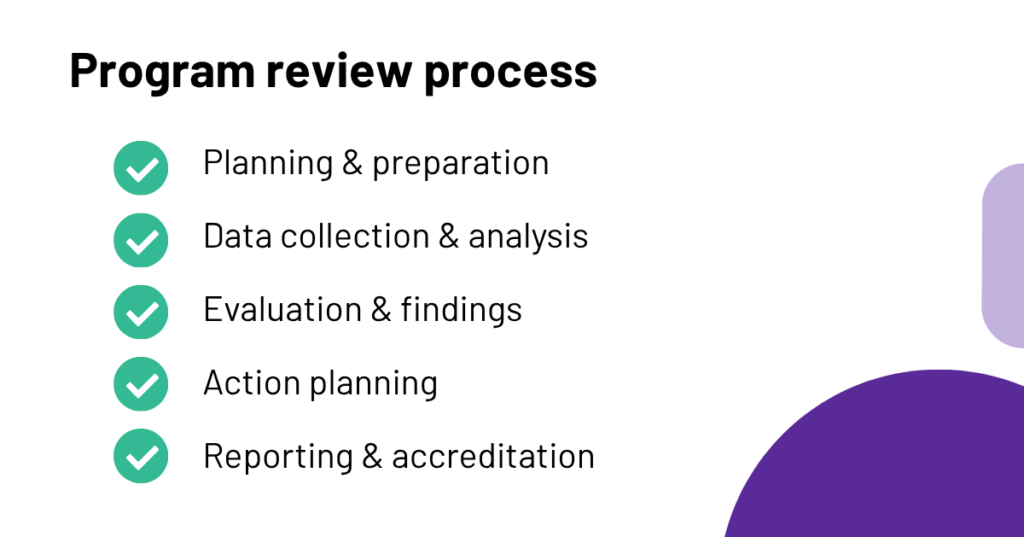
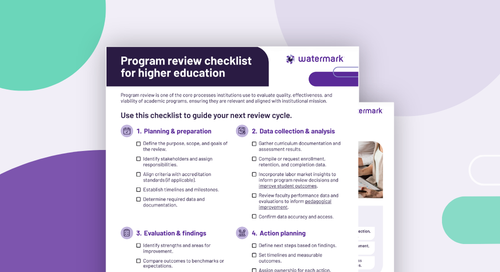
Program review checklist
A successful review follows a clear, repeatable process. Use this checklist to guide your next review cycle:
Planning & preparation
- Define the purpose, scope, and goals of the review.
- Identify stakeholders and assign responsibilities.
- Align criteria with accreditation standards.
- Establish timelines and milestones.
- Determine required data and documentation.
Data collection & analysis
- Gather student learning outcomes and assessment results.
- Compile enrollment, retention, and completion data.
- Incorporate labor market insights to inform program review decisions and improve student outcomes.
- Review faculty performance data and evaluations to inform program improvement.
- Confirm data accuracy and accessibility.
Evaluation & findings
- Identify strengths and areas for improvement.
- Compare outcomes to benchmarks or expectations.
- Document findings with supporting evidence.
- Connect results to program and institutional goals.
Action planning
- Define next steps based on findings.
- Set timelines and measurable outcomes.
- Assign ownership for each action.
- Align plans with broader institutional priorities.
Reporting & accreditation
- Document the review process clearly and consistently and maintain records for future review cycles and audits.
- Prepare materials and ensure alignment with standards for institutional and/or programmatic accreditation, or internal reporting
Want to save this interactive checklist for later?
Common challenges in program review
Even with a structured approach, institutions often encounter challenges:
- Manual processes that slow data collection and reporting
- Disconnected systems that limit visibility
- Inconsistent approaches across departments
These make it harder to demonstrate progress and respond to accreditation standards with confidence. A more centralized approach can help institutions bring data, workflows, and reporting into one place.
How to improve program review processes
Improving program review often comes down to consistency, visibility, and scalability:
- Centralize data and workflows: Managing data, documentation, and workflows in one place reduces duplication and improves accuracy.
- Standardize reporting cycles: Consistent templates, timelines, and expectations help ensure each review follows a repeatable process.
- Use technology to scale: As programs and reporting requirements grow, technology can streamline data collection, simplify reporting, and maintain consistency, especially when paired with solutions like Watermark Faculty Success that support evaluating faculty performance, activity reporting, and credentialing.
How Watermark supports program review
Watermark streamlines institutional workflows by bringing clarity, structure, and centralized visibility to the program review lifecycle. By adopting a unified framework, colleges and universities can:
- Manage planning, data collection, and reporting in one place.
- Align program review with accreditation expectations.
- Connect outcomes, assessment, and decision-making.
- Maintain consistency across programs and review cycles.
The goal isn’t just to complete reviews, but to make them more meaningful for decision-making.
A clear, consistent approach to program review improves both accreditation readiness and long-term program quality. When processes are structured, and data is accessible, teams can spend less time assembling reports and more time acting on insights.
Request a live demo today to see how easy it is to complete each step of the program review process with our centralized solution.