Artificial intelligence is becoming more common across higher education. Faculty and staff are testing tools to summarize information, analyze data, and reduce administrative work. But how can institutions move beyond isolated experiments, integrate AI into their operations, and scale AI responsibly?
For provosts, the challenge is connecting experimentation to institutional priorities while protecting academic integrity, faculty trust, and institutional data through a thoughtful approach to responsible AI in higher education.
The limits of isolated AI experiments
A standalone AI tool can make a task easier. A department might use one application to summarize reports while a faculty group pilots another to organize information. But these experiments do not automatically add up to an institutional strategy.
Disconnected tools can create additional work. Teams must assess security and privacy risks, manage access, maintain integrations, and verify outputs. Without clear governance and an understanding of institutional data, a quick prototype can become another system for staff to support.
Demonstrating what AI can do is one thing. Building the infrastructure and governance to use it responsibly at scale is another.
Connect AI strategy to the work of academic leadership
Provosts are not short on data. The challenge is bringing information from across departments together. Evidence about student outcomes, course feedback, faculty accomplishments, curriculum, and program costs may sit in separate systems or departments. Evaluating program health and academic viability can therefore require significant coordination.
Connecting this information gives academic leaders a clearer picture of institutional performance. They can better evaluate program health, identify areas that need attention, consider changes to the academic portfolio, and understand student and curricular outcomes alongside faculty contributions. These applications illustrate how AI is transforming higher education.
Making institutional data more accessible should support academic judgment, not replace it. It also gives faculty committees and academic leaders a shared foundation for informed decisions.
Scale responsible AI without losing the human element
The work of scaling responsible AI requires more than choosing tools. Institutions need a framework that reflects their policies, security requirements, and academic values.
Start by distinguishing administrative support from decisions that depend on human expertise. AI can help teams organize information, synthesize reports, and identify patterns. But faculty oversight and academic judgment remain essential, particularly in teaching, learning, and evaluation.
Transparency is equally important. Leaders should be able to understand where an AI-generated summary or insight came from, review its supporting evidence, and recognize its limitations. Effective AI governance also means defining who can access particular capabilities and information, with permissions that align with institutional policy.
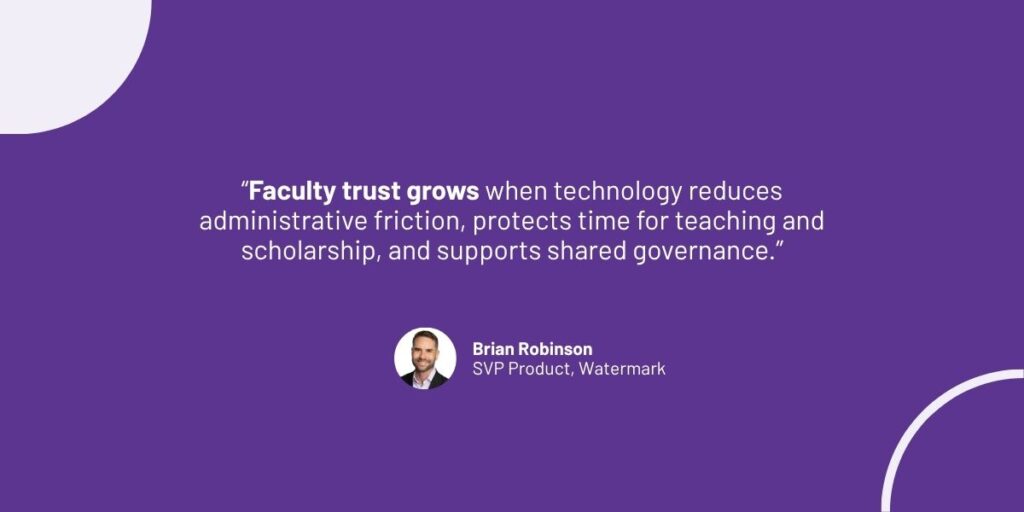
Finally, involve the people whose work will be affected. Faculty trust grows when technology reduces administrative friction, protects time for teaching and scholarship, and supports shared governance.
Move from experimentation to institutional alignment
No single tool or policy will solve every challenge. Institutions can make progress by treating scaling AI as a strategic effort rather than a collection of unrelated pilots. This means connecting information across campus, establishing expectations for responsible use, and choosing systems and partners that can support institutional needs over time.
AI can do more than speed up existing processes. It can give academic leaders and faculty the context they need to make informed decisions about program health, institutional priorities, and the future of higher education.
For provosts, scaling AI responsibly means connecting institutional information while preserving the academic judgment and oversight that guide campus decisions.
Sign up for our webinar happening December 1 as we dive deeper into this topic: The provost’s AI dilemma: Vision, adoption, and risk.