As legislative activity around faculty tenure and accountability continues to evolve, post-tenure review is becoming an increasingly important focus for colleges and universities.
While requirements vary by institution and state, leaders need faculty review processes that are consistent, transparent, and supported by clear documentation that can withstand institutional and regulatory review.
For many institutions, the challenge is balancing external accountability with the principles of academic freedom that tenure is designed to protect.
Why post-tenure review is changing
Recent legislative activity has expanded post-tenure review requirements in several states, with new laws and policies increasing review frequency or adding performance expectations.
Faculty organizations have also shaped the conversation. The American Association of University Professors (AAUP) supports faculty evaluation when it is designed to promote professional growth, is developed and carried out through shared governance with faculty leadership, and protects academic freedom. At the same time, the AAUP cautions against review processes that function as a re-evaluation of tenure or weaken due process protections.
As requirements evolve, institutions are reassessing how faculty activities, teaching effectiveness, and service are documented to ensure review processes remain fair, consistent, and aligned with policy expectations.
Key compliance challenges for institutions
As post-tenure review expectations evolve, institutions face several common challenges:
- Applying review criteria consistently across departments and disciplines
- Maintaining complete, centralized documentation of faculty activities and achievements
- Incorporating multiple sources of evidence, including teaching effectiveness, scholarship, service, and, where applicable, course evaluation data
- Demonstrating that review processes align with institutional policy and state requirements
Without standardized processes, preparing for reviews can become time-consuming for both faculty and administrators.
Characteristics of an effective review process
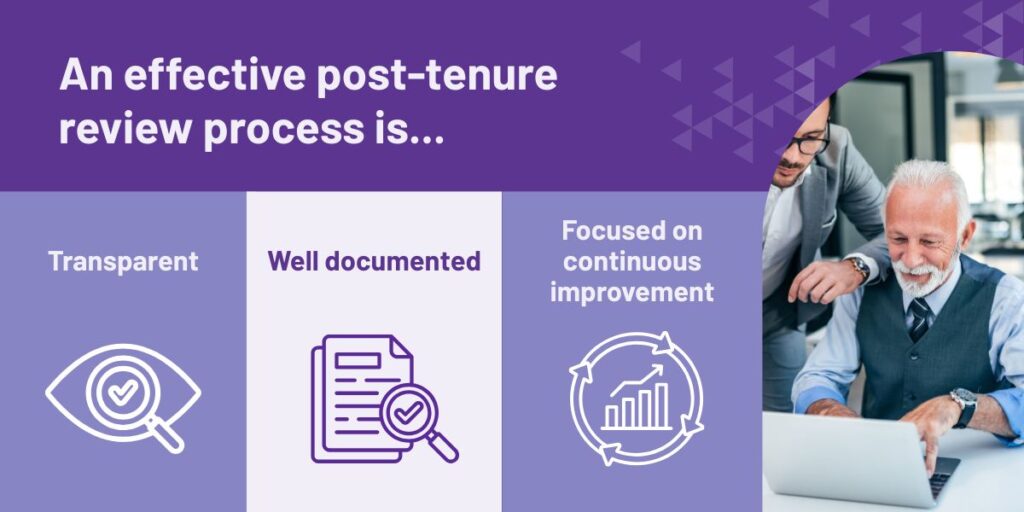
An effective post-tenure review process is transparent, well documented, and focused on continuous improvement rather than compliance alone. Clearly defined expectations, consistent evaluation criteria, and organized evidence help institutions support faculty while demonstrating accountability, reducing administrative burden, and creating a more defensible review process.
Many institutions also rely on multiple forms of evidence (including faculty activity records, annual reviews, peer evaluations, and course evaluation results) to provide a more complete picture of faculty performance over time.
Preparing for future requirements
As legislative and policy expectations continue to evolve, institutions with clear, repeatable post-tenure review practices will be better positioned to adapt. Centralized records and reliable reporting can reduce administrative burden while supporting faculty professional development.
Watermark’s Faculty Success helps institutions collect and organize faculty activities, accomplishments, and supporting documentation used across faculty review processes, including post-tenure review. Course Evaluations & Surveys provide valuable student feedback that can serve as one source of evidence within a comprehensive faculty review process. Together, these solutions help institutions streamline faculty review workflows, centralize faculty records, support evidence-based decision-making, and maintain consistent, audit-ready documentation for evolving institutional and state requirements.
Request a live demo to see how Watermark simplifies faculty review, reporting, and post-tenure review documentation.