Table of contents:
The program review paradox
Retiring obsolete metrics
Unburdening department chairs
Driving faculty ownership
The portfolio assessment model
Managing program viability discussions
The role of AI in program review
Next steps for campus leaders
The program review paradox
Higher education no longer enjoys an insulated existence. Shifting demographics, evolving workforce requirements, heightened public skepticism over institutional value, and tightening budgets mean that every academic program must regularly prove its worth. Yet, the primary administrative tool you rely on to evaluate quality—the academic program review (APR)—is facing unprecedented scrutiny from the very leaders and faculty expected to carry it out.
For decades, the standard academic program review has followed a familiar cadence: every five to seven years, department chairs and faculty embark on a months-long marathon of gathering data, writing exhaustive self-reflection essays, and compiling three-ring binders (or massive PDF files) for external reviewers. The exercise demands dozens, sometimes hundreds, of administrative hours. But once the external team leaves and the final report is stamped complete, what actually happens?
All too often, these massive reports end up sitting on a digital shelf gathering metaphoric dust. The recommendations rarely tie into institutional budget allocation, curricular innovations stall in committee backlogs, and faculty walk away feeling drained by what felt like a compliance-driven, bureaucratic requirement rather than an authentic strategic opportunity.
If academic program review is to remain relevant in modern higher education, we must ask ourselves a fundamentally uncomfortable question: Are we still asking the right questions, or are we simply completing the same traditional routines out of habit?
To transform program review into a meaningful, continuous improvement engine, leaders in Academic Affairs, Institutional Effectiveness (IE), and Institutional Research (IR) must critically re-examine their evaluation frameworks. We need to retire obsolete metrics, reduce administrative friction, engage faculty in authentic inquiry, and build governance structures that ensure findings lead to actionable resource allocation.
Learn how Watermark can help you generate a clear picture of program health
Retiring the obsolete
Every assessment cycle introduces new opportunities to gather data—yet institutions rarely stop collecting existing metrics, even after they have lost their diagnostic value. Traditional program review frameworks were designed for an era when program health was defined almost exclusively by enrollment volume, faculty credentialing, and departmental boundaries.
In today’s ecosystem, relying solely on legacy metrics can yield misleading conclusions. Consider how traditional metrics compare to the modern, strategic indicators required for modern institutional planning:
| Evaluation dimension | Traditional APR metric (obsolete) | Modern strategic indicator (next-gen) | Strategic rationale |
| Program health & growth | Total credit hour production & headcount | Net program viability & retention pathways | Raw headcount obscures DFW rates, course bottlenecks, and student completion trends across demographics |
| Student learning quality | Isolated direct assessment scores / course grades | Integrated learning growth & post-grad success | Course-level grades rarely isolate core competencies or reflect long-term skill acquisition |
| Curricular relevance | Traditional departmental silo offerings | Multi-credential stackability & interdisciplinary reach | Micro-credentials, certificates, and cross-departmental pathways reflect modern student demand |
| Resource utilization | Cost per student/ budget allocation history | Return on instruction & strategic resource needs | Replaces passive financial tracking with proactive links between program findings and budget requests |
| Faculty performance | Standard research & teaching output counts | Holistic workload, mentorship, & impact | Accounts for total faculty contribution to student success and reduces operational burnout |
When we shift the metrics from simple activity counts to holistic impact indicators, program review transforms from a retrospective audit into a forward-looking roadmap.
Unburdening department chairs with data exploration
Ask a department chair about their biggest frustration with program review, and you will hear a consistent theme: the data gathering burden.
In a traditional review cycle, department chairs spend weeks acting as amateur data miners. They hunt through separate institutional systems, paste figures into disconnected spreadsheets, and manually build chart after chart detailing retention rates, student demographics, enrollment trends, and financial aid distribution. By the time they actually sit down to write the narrative, they are emotionally and operationally exhausted.
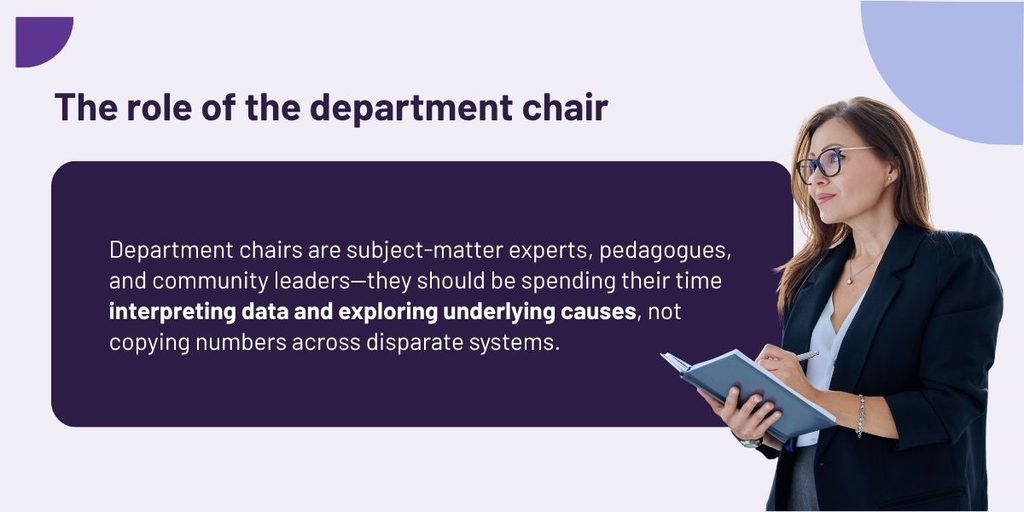
This dynamic fundamentally misunderstands the role of academic leadership. Department chairs are subject-matter experts, pedagogues, and community leaders—they should be spending their time interpreting data and exploring underlying causes, not copying numbers across disparate systems.
To streamline this process, progressive institutions are building integrated data ecosystems that bring together IR, learning outcomes assessment, and student feedback into centralized platforms.
When institutional systems automatically populate baseline metrics—such as 5-year enrollment trends, course success rates disaggregated by demographic, and post-graduation placement statistics—department chairs can skip the manual assembly and jump straight to exploratory questions:
- We see a 12% drop in persistence between the second and third year for transfer students. What structural barrier in our curriculum might explain what we are seeing?
- While overall rubric scores for written communication are strong, where do we see gaps when students tackle complex, quantitative synthesis?
- How are our graduates leveraging specialized skills in non-traditional career pathways three years after completion?
By connecting assessment data with broader institutional data, we convert program review from an exercise in data gathering into an authentic process of institutional discovery.
Moving from compliance to authentic faculty ownership
Top-down mandates rarely inspire meaningful pedagogical change. If program review feels like an external compliance checklist designed solely to satisfy regional accreditors or state governing boards, faculty will give it the bare minimum effort required to pass.
To cultivate authentic, faculty-led continuous improvement, institutional leaders must intentionally design reviews around shared inquiry, pedagogical autonomy, and meaningful dialogue:
1. Refocus qualitative self-reflection
Qualitative essays in program reviews often devolve into boilerplate, self-congratulatory narratives. Replace generic narrative prompts with targeted, evidence-informed reflection. Require departments to identify two or three core pedagogical questions they want to investigate during their review cycle.
2. Respect disciplinary nuance
Standardized, institution-wide metrics provide necessary baseline consistency, but they must be balanced against the unique mission and context of specialized programs. A professional clinical program, a performing arts department, and a research-heavy STEM major require distinct evaluation criteria. Allow programs to define specialized key performance indicators that align directly with their disciplinary standards.
3. Establish clear governance links
Faculty lose faith in program review when their thoughtful recommendations disappear into an administrative vacuum. Establish formal governance structures that explicitly tie program review outcomes to institutional planning, equipment funding, staffing requests, and space allocations. When faculty see that a rigorous program review directly results in funding for a new lab, a revised curriculum, or a dedicated advising resource, participation changes overnight from passive compliance to active engagement.
“A drop of perfect” vs. “An ocean of purposeful”
In assessment and institutional effectiveness, we often witness a clear cultural divide across campuses:
- A drop of perfect: A small handful of academic departments conduct deeply sophisticated, exemplary, research-grade assessment reviews—while the majority of campus struggles to meet baseline expectations.
- An ocean of okay: Every program across the institution submits a standard, modest review on time, but the process lacks depth, spark, or transformative insight.
While an exemplary, deep-dive review is inspiring, perfection is fundamentally unscalable across dozens of academic programs with limited time and resources. What institutions actually need is an ocean of purposeful assessment.
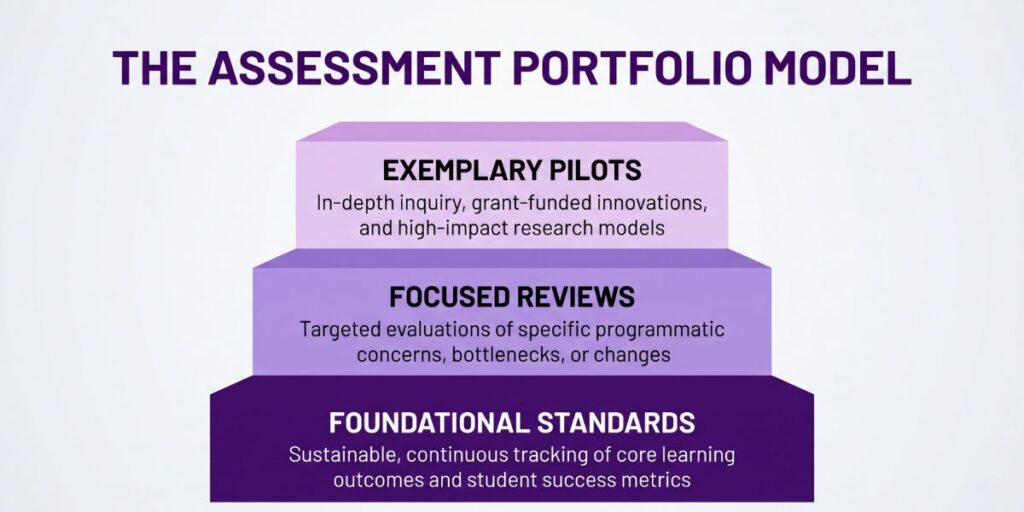
Instead of requiring every single program to perform an exhaustive, 100-page overhaul during every review cycle, progressive institutions are adopting a differentiated Portfolio Assessment Approach:
- Foundational maintenance: All programs maintain ongoing, sustainable tracking of core student learning outcomes, retention rates, and student feedback using central dashboards.
- Focused reviews: Programs facing specific challenges (e.g., shifting accreditation requirements, sudden enrollment drops, or major curricular redesigns) perform targeted, deep-dive reviews supported by institutional resources.
- Exemplary pilots: High-performing or innovative programs are granted pilot funding to test new assessment models, interdisciplinary stackable credentials, or AI-assisted reflection tools.
By allowing programs to move fluidly between these levels based on institutional context and developmental needs, we build a continuous, manageable model that honors faculty capacity while preserving rigor.
Stop letting program review reports gather dust
Managing sensitive conversations
Perhaps the most challenging aspect of academic program review occurs when the data points toward declining programmatic viability. Whether driven by shifting career markets, persistent low enrollment, or strategic budget reallocations, discussions surrounding program modification or phase-out are inherently emotionally charged and sensitive.
When managed poorly, program viability reviews lead to defensiveness, mistrust, and institutional panic. Leaders who have successfully navigated these complex decisions share several critical principles:
- Separate program quality from program viability: A program can be pedagogically brilliant, highly rigorous, and loved by students, yet still face low demand or unsustainable cost structures. Frame conversations around market alignment and strategic fit, rather than making faculty feel their teaching quality is being criticized.
- Establish transparent thresholds early: Program review criteria for financial sustainability and enrollment viability should be clear, standardized, and published well in advance—not invented mid-cycle in response to a budget crisis.
- Focus on student and community transitions: Conversations regarding program phase-outs must lead with clear teach-out plans, faculty transition pathways, and possibilities for re-stacking existing courses into non-degree, certificate, or interdisciplinary offerings.
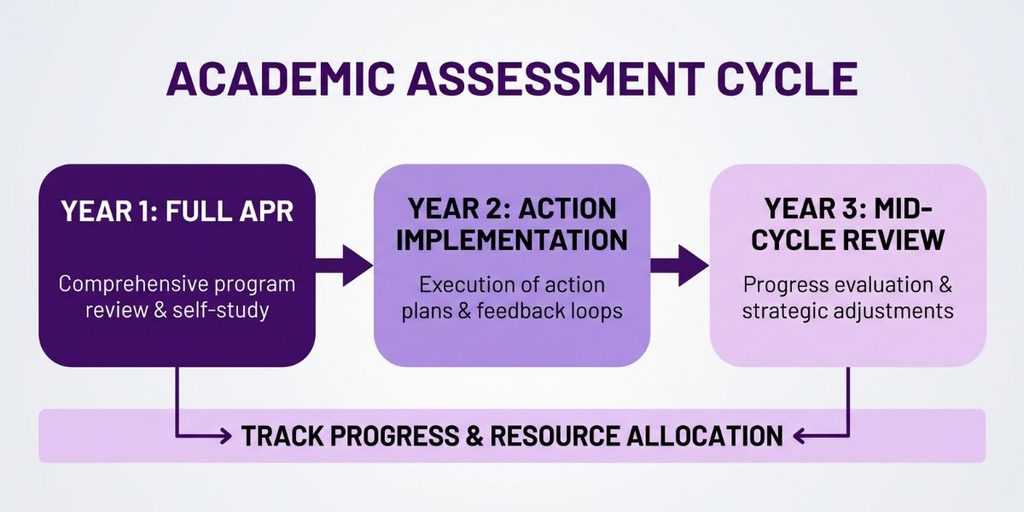
Closing the loop with a 2-to-3 year follow-up structure
A program review is only as valuable as the actions it produces. Yet, one of the most common failure points in higher education evaluation occurs 24 to 36 months after the initial review is completed.
In year one, excitement is high, reports are filed, and commendations are shared. But by year three, leadership changes, new priorities emerge, and the action plan created during the review is forgotten.
To prevent recommendation decay, institutions should implement a lightweight, formal mid-cycle check-in:
- Action item dashboards: Maintain a centralized repository where program action items, responsible leaders, target completion dates, and budget requests are explicitly tracked.
- The 3-page mid-cycle update: Three years post-review, department chairs submit a brief, 3-page update detailing:
- Which recommendations have been fully implemented?
- What measurable changes in student learning or persistence have resulted?
- What barriers or resource constraints are holding back remaining goals?
This simple structure ensures that program review remains an active, continuous dialogue rather than a once-a-decade obligation.
The role of AI: accelerating discovery without replacing judgment
As artificial intelligence platforms become integrated into educational management systems, their role in academic program review is growing rapidly. However, higher education leaders must draw a clear distinction between administrative acceleration and authentic reflection.
Where AI adds clear value
- Synthesizing multi-year narratives: AI can analyze qualitative feedback across five years of assessment reports to surface recurring thematic barriers or cross-departmental opportunities.
- Data cleaning & visualization: Automatically structuring survey feedback, formatting complex rubric results, and creating accessible summaries for review committees.
- Prompting exploratory questions: Assisting department chairs by suggesting nuanced research questions based on observed trend data.
Where human judgment is non-negotiable
- Interpreting learning & context: AI can highlight statistical patterns, but only faculty possess the contextual knowledge to explain why students struggle with specific concepts.
- Setting program vision: Defining the mission, values, and strategic direction of an academic community requires human empathy, ethics, and collective leadership.
AI should be leveraged to clean data, reduce administrative burden, and generate preliminary summaries—freeing human minds to focus on dialogue, teaching, and strategy.
Next steps for institutional leaders
If your institution is preparing for its next academic program review cycle, start by gathering your Academic Affairs, IE, and IR teams to reflect on your current process:
- Audit your current metric list: Identify at least two legacy metrics that take significant effort to collect but rarely influence decisions—and eliminate them.
- Centralize data delivery: Work with your IR team to build automated, baseline data templates for department chairs before the writing phase begins.
- Connect reviews to budgets: Ensure your institutional resource planning committee explicitly reviews APR action plans during annual budget cycles.
- Schedule the mid-cycle check: Establish a brief 2-to-3-year follow-up mechanism to track progress on prior recommendations.
Academic program review does not have to be a resource-intensive compliance exercise. By asking the right questions, unburdening our department chairs, and connecting data across institutional silos, we can transform program review into what it was always meant to be: a powerful catalyst for continuous improvement and student success.